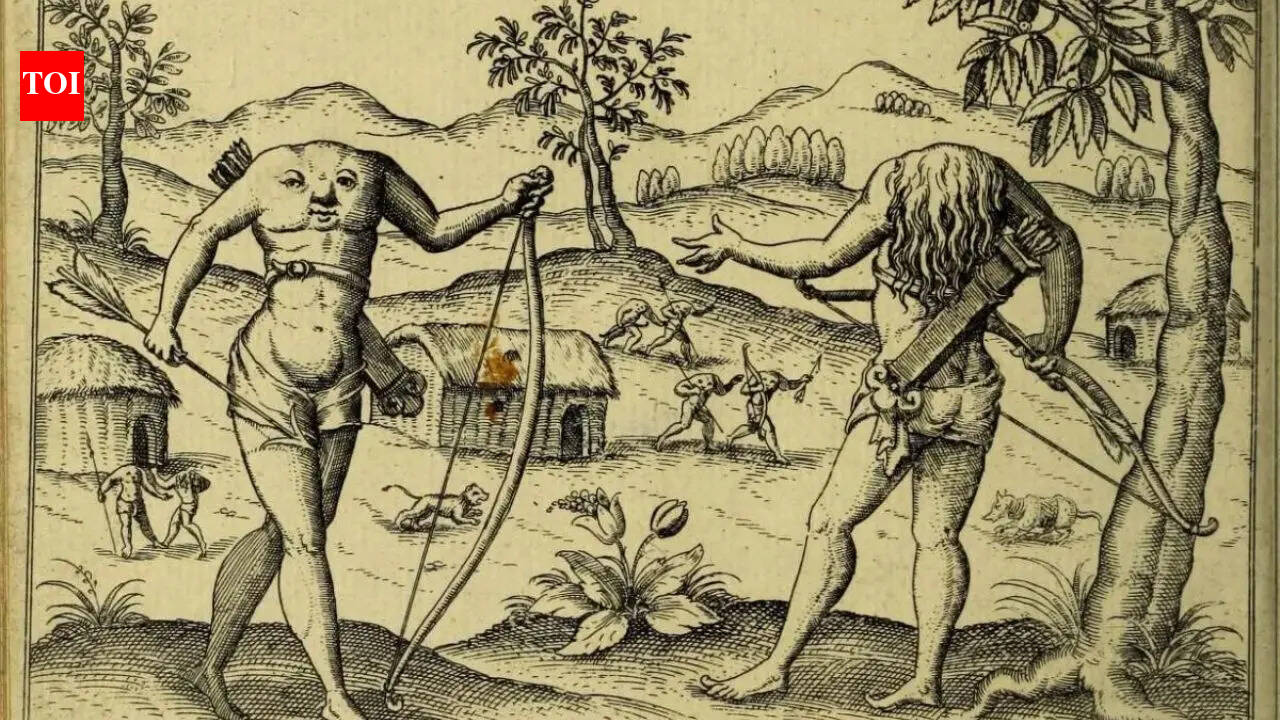
The ancient world was full of strange creatures and legends, the most famous being the Blemmyes. Historians like Pliny the Elder and Herodotus chronicled the supposed existence of these ‘headless’ beings; they were described as being seen in the Nubian deserts with human eyes and mouths on their chests. As evidenced by medieval bestiaries, the Blemmyes were depicted as monstrous beings. Medieval bestiaries depict the Blemmyes as monstrous beings. Modern historians suggest that the Blemmyes were a nomadic group involved in military campaigns. Their distinctive military uniforms, including tunics and shields held close to their faces, might have made them seem monstrous from a distance. The transformation of the Blemmyes from a real desert culture into an imagined, monstrous entity is a notable example of cultural misunderstanding. Herodotus is the first to mention the story of the headless men in Western literature.
When ancient historians believed in ‘headless men’ as real
Herodotus is the first person to include the story of the headless men in the Western literary canon. According to the Library of Congress, he referred to these mythical creatures as ‘akephaloi’ and claimed they lived in eastern Libya. The Roman historian Pliny the Elder would solidify this claim by naming them ‘Blemmyes’ and describing them as having no heads, with their eyes and mouths located on their chests. For many centuries, explorers treated these ancient accounts of the Blemmyes not as fabricated folklore, but rather as factual accounts of biological certainty; they were terrified of what lay beyond the ‘edges’ of the known world.
When the monstrous Blemmyes conquered Upper Egypt
The Blemmyes were a very real and powerful nomadic ethnic group that lived in the Eastern Desert (in the modern-day territory of Sudan and Southern Egypt). As per the book ‘A Guide to the Egyptian collections in the British Museum’, they were also an ever-present military threat to the vast Roman Empire, with continuous historical records of Blemmyes invading the Roman province of Egypt (Upper Egypt) throughout the 3rd to 5th centuries CE. Blemmyes even took part in Upper Egypt (of which Thebes was the capital city) as a result of military campaigns directed against the Romans. Far from being ‘monsters,’ the Blemmyes were sophisticated enough to unite as a kingdom and enter into negotiation treaties with such Roman Emperors as Diocletian.
How desert heat and armour created a ‘headless’ warrior
Recent researchers argue that ‘headless’ forms originated due to military camouflage and uniforms. High-waisted garments worn by Blemmyes often obscured the cervical profile in the heat of battle when using large shield-sized long weapons for protection; holding the shield in this manner while charging would block off or cover the wearer’s neck so that over long distances against a haze of heat from the desert the visual appearance was that of a head and neckline being obscured by the width of the weapon.
How a desert tribe became a global monster
According to the British Library, the image of Blemmyes has continued to be used as an illustration of extraordinary creatures in Mappa Mundi and bestiary illustrations since they were representatives of an outsider, illustrating the perils of unknown territory in the east and Africa, and showing in exotic detail what could be dangerous near the region. In addition to maps and bestiaries, Blemmyes have also been documented in works such as the Nuremberg Chronicle and Sir Walter Raleigh’s accounts from 1595 about ‘men with eyes on their shoulders’; these accounts indicate how a misunderstanding about an actual tribe has transformed over large geographic distances into depictions of ‘monsters.’