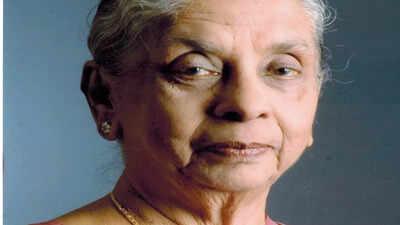
It is the 1950s in India. A young republic that has just learnt the language of freedom, still searching for its rhythm, still testing the weight of its own promises. It dates back to a society when women were shackled with prejudices and stereotypes, when it was difficult for a woman even to imagine completing her studies, let alone stepping into corridors of power that had, for generations, been reserved for men. But there came a woman who defied the pre-existing notions and knew what she deserved. This is the story of Anna Rajam George, the first female IAS officer of India. As it is said, it seems impossible until it is finally done. Anna opened the doors and left marks for millions of others to follow.When she entered the interview room, a group of senior ICS officers sat across the table. They had spent years deciding who could handle authority, who could not, and what “suitability” meant for government service. Their evaluation followed familiar patterns shaped by decades of tradition. Anna Rajam did not fit those patterns. They were accustomed to seeing male officers, and a woman entering the role was not something they were ready to accept easily.
A start shaped far from power
She was born in 1927 in Niranam in Kerala and raised in Kozhikode. Her early years moved around education, books, and steady academic discipline rather than public attention or visibility.She studied at Providence Women’s College and later at Malabar Christian College. In 1949, she completed her master’s degree in English literature from the University of Madras.A year later, she took the civil services examination. She cleared it. With that result, she became the first woman in India to enter the Indian Administrative Service.
A suggestion she refused to accept
At the interview stage, she was advised to consider the Foreign Service or other central services. The reasoning reflected the thinking of that period, those roles were described as more suitable for women.The suggestion was presented as guidance based on experience. Anna Rajam chose a different path. She remained with the IAS cadre and did not shift to alternative services.That decision set the direction for everything that followed.
A posting that tested expectations
Her first assignment came in Madras State. Even after selection, field postings for a woman officer were still viewed with hesitation.C. Rajagopalachari, then Chief Minister, reportedly preferred assigning her to a secretariat role rather than district administration. Anna Rajam had trained for field work, including horse riding, rifle and revolver handling, and use of magisterial authority.She declined a desk-based posting. She took charge as Sub Collector of Tirupattur. With that, she became the first woman in India to hold the position of Sub Collector.
A career that expanded government space
From that point, her work moved through multiple levels of administration. She served in the Madras government in departments including Agriculture and Public administration. She later moved to the Government of India as Deputy Secretary in the Ministry of Finance and then as Additional Secretary in the Ministry of Agriculture.She went on to lead the National Seeds Corporation as Chairperson, contributing to agricultural systems during a period of national expansion.Later, she reached one of the highest positions in the civil services as Secretary to the Government of India in the Ministry of Education and Culture. She became the first woman to hold that post.She worked on major national projects, including the Asiad Project alongside Rajiv Gandhi, and collaborated at various points with Indira Gandhi.
Leadership at Nhava Sheva
One of her major administrative roles came as Chairperson of Nhava Sheva Port Trust in Mumbai. During her tenure, Nhava Sheva, now Jawaharlal Nehru Port, became India’s first computerised port.This transition moved operations from manual systems to digital processes, improving coordination, speed, and efficiency at one of the country’s most important maritime gateways.
Recognition and legacy
In 1989, she received the Padma Bhushan for her contribution to public service. By then, her career had already become part of India’s administrative history. She passed away in September 2018 at the age of 91.What her journey representsAnna Rajam Malhotra’s life is often described through milestones, the first woman IAS officer, the first woman Sub Collector, the first woman Secretary to Government of India.Those labels capture facts, not the full journey. A young woman was told she should choose a different path. She did not. She stayed in the system, worked through its layers, and reached positions that were once considered out of reach for women.Over time, what looked unusual became part of how the system began to function.