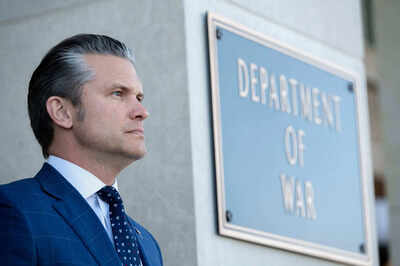
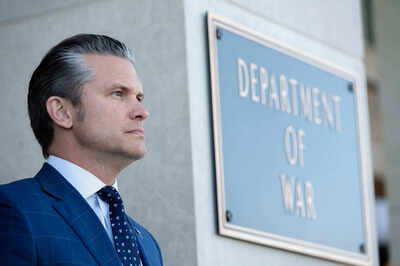
The United States Department of Defense will prohibit members of the armed forces from attending Columbia University, Yale University, Brown University and several other institutions beginning next academic year. The move is part of a broader effort by the administration to sever ties with universities that Defense Secretary Pete Hegseth has accused of fostering what he described as anti American sentiment.In a video posted to social media on Friday, Hegseth said the targeted universities had become “factories of anti American resentment” and “breeding grounds of toxic indoctrination.” He did not cite specific evidence for the claims.Hegseth said the ban would apply to Columbia, Princeton University, Brown, Yale University and the Massachusetts Institute of Technology, along with “many others,” without detailing the full list. He called for “complete and immediate cancellation of all Department of War attendance,” though it remains unclear how broadly that directive will be interpreted.
What changes for service members
The Department of Defense currently operates a Tuition Assistance programme that covers the full cost of tuition for active duty personnel at approved institutions. As of Friday, Columbia, Brown, MIT and Harvard University were still listed as eligible institutions in the Pentagon database, the Associated Press reports.The most recent data shows that 39 service members attended Harvard in 2023 under the programme, while Columbia had nine participants and the Massachusetts Institute of Technology had two.An earlier action targeting Harvard sought to block military members from attending certain graduate level professional military education programmes, fellowships and certificate courses. It was not immediately clear whether the new policy would extend to programmes such as the Reserve Officers’ Training Corps.Harvard has historically offered professional development and degree programmes tailored to Pentagon personnel. Last year, it introduced a master’s degree in public administration designed for active duty military members and veterans. Hegseth himself earned a master’s degree from Harvard and returned his diploma publicly in 2022 during a television segment, according to AP.
A wider campaign against elite campuses
The policy comes amid sustained pressure from President Donald Trump’s administration on several Ivy League campuses. Trump has repeatedly accused elite universities of promoting what he calls “woke” ideology. His administration has cut billions of dollars in research funding and launched investigations into allegations that universities failed to address antisemitism on campus.Columbia and Brown were among institutions that reached agreements with the White House in recent months, agreeing to certain demands in exchange for restoration of federal funding. Harvard has taken a different approach and is contesting the administration’s actions in court, alleging unlawful retaliation tied to ideological disagreements.Earlier this month, Trump said Harvard would need to pay one billion dollars to the government as part of any settlement. That figure is double a previously stated demand, according to AP.
Structural implications
For the military, civilian graduate education has long functioned as a bridge between uniformed service and broader policy, research and administrative networks. Officers often pursue advanced study either at military war colleges or at civilian universities.Restricting access to specific civilian institutions narrows those pathways. It does not end graduate education for service members, but it reshapes where that education can occur and which intellectual environments remain open to them.The practical impact will depend on how the Pentagon defines attendance restrictions, how quickly eligibility lists are updated and whether Congress or the courts intervene. For now, the institutions remain in the tuition database. The policy announcement signals intent. Its operational boundaries are still being drawn.