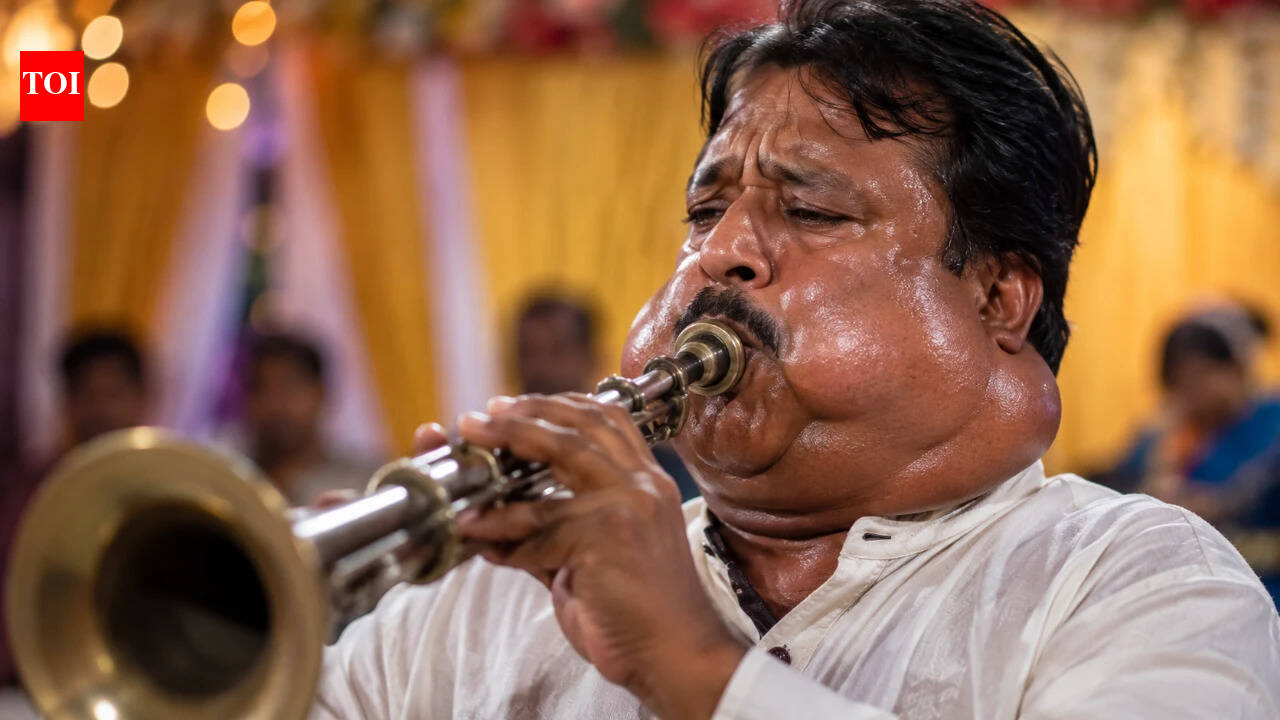
A video doing the rounds on social media captures one such moment. A man is seen playing a wind instrument at what appears to be a function. He continues performing, but something unusual becomes increasingly noticeable. Every time he blows into the instrument, parts of his face and neck appear to swell outward before settling back.For many viewers, the striking part is not simply the unusual physical reaction. It is the image of someone continuing with his work despite looking visibly uncomfortable. The clip has therefore been interpreted by many as a reminder of the quiet responsibilities people carry for their families.
The swelling may have a medical explanation
The dramatic change seen in the man’s neck does not necessarily mean that his throat is permanently swollen.One possibility is a pharyngocele, a rare condition in which part of the pharyngeal wall bulges outward because of increased pressure inside the throat. Another possibility is a laryngocele, which involves an abnormal air-filled enlargement of a structure connected to the larynx.Both conditions can become more noticeable during activities that sharply increase pressure in the throat.Wind instruments are one example. Players repeatedly blow against resistance, creating pressure within the upper airway. In some people, that pressure can produce a temporary bulge that becomes visible only while playing.A case report published through the US National Library of Medicine’s PubMed/PMC database described a trumpet player whose neck appeared normal at rest but developed obvious swelling while playing. Examination during trumpet blowing confirmed a pharyngocele.That makes the video particularly interesting. The unusual movement may look alarming to someone watching it for the first time, but a pressure-related structural change is one possible medical explanation. It would still be wrong to diagnose the man from a social media video.
The quiet side of responsibility is often invisible
The emotional reaction to the clip is understandable. Across families, there are people who keep working when they are tired. Some continue through long commutes, physical discomfort, financial pressure or responsibilities at home. Their work may not look dramatic from the outside. Yet it can hold together an entire household.That does not mean suffering should be romanticised.There is a difference between resilience and being forced to endure something because stopping is not an option. Calling every struggle “strength” can sometimes hide the fact that people need rest, medical care, safer working conditions or financial support.That distinction is particularly important for musicians and other workers whose bodies are central to their livelihood.If playing a wind instrument repeatedly causes swelling, pain, voice changes, breathing difficulty or swallowing problems, continuing without assessment may not be sensible. Doctors can examine the throat and neck and, when needed, use imaging or endoscopic examination to determine what is actually happening.Medical literature also shows why a proper diagnosis matters. Laryngocele and pharyngocele are different conditions, and the swelling seen during pressure-producing activities may need to be reproduced during examination to understand its cause.Behind a performance can be a body working much harder than the audience realises. Behind a working face can be a person carrying responsibilities that remain unseen. And behind an unusual physical reaction can be a medical condition that deserves curiosity rather than ridicule. Perhaps that is a better way to look at resilience.Not as a person refusing to break at any cost, but as someone whose effort deserves to be noticed, and whose health deserves to matter too.Disclaimer: The medical explanation in this article is based on conditions reported in medical literature and is not a diagnosis of the person shown in the video.