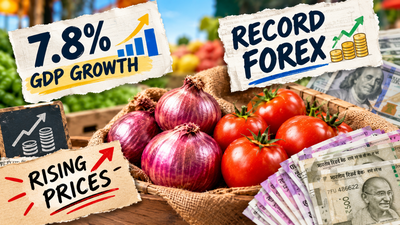
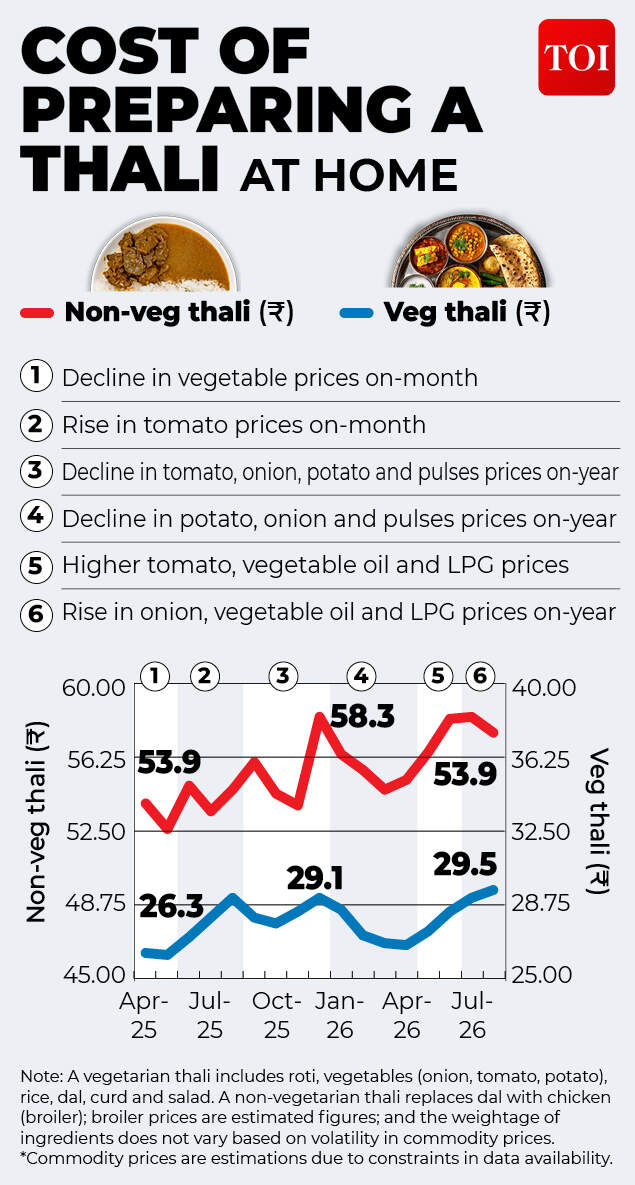
India’s economy clocked a herculean 7.8% growth in the April-June quarter of FY27. But is the average Indian feeling the boom?Despite global turbulence from the US-Iran conflict which has led to a shaky world economy, India’s growth story is looking surprisingly solid. GDP grew 7.8% in the first quarter of FY27, comfortably beating the Reserve Bank of India’s 7% estimate.The forex numbers are looking just as strong. India’s foreign exchange reserves crossed $740 billion, hitting a fresh record after rising for nine consecutive weeks.On paper, there is plenty to celebrate. But there’s a catch.While GDP is growing and forex reserves are climbing, the grocery bill is telling a slightly different story. Sugar, onions, edible oils and milk, everyday kitchen basics, are getting costlier, leaving households to deal with a very different side of India’s economic story.The squeeze is already visible in the cost of a basic thali. A vegetarian thali became 1% more expensive year-on-year in August, while a non-vegetarian thali rose 5%. The sharper increase in the latter was largely driven by broiler prices, which rose an estimated 10% and account for around half the cost of a non-veg plate.So, while some vegetables became cheaper, households continued to feel the pinch as higher prices of key ingredients outweighed the relief elsewhere.And the pressure could show up in overall inflation too. According to a Union Bank of India report, India’s retail inflation is expected to rise to 4.88% in August. Food inflation is expected to climb to 6.03% in August from 5.24% in July.Vegetable prices, however, could offer some relief, with vegetable inflation expected to ease sharply to 0.39% year-on-year. But that breather may not last, as price pressures in other essential food items continue to keep the kitchen budget under strain.
Price pressure at dining table
Sugar tastes less sweeter
The pressure is starting right at the breakfast table, and sugar is at the centre of it.Sugar prices rose 19% year-on-year and 20% quarter-on-quarter. The all-India average retail price climbed to around Rs 62 a kg in September from about Rs 47 in June, according to consumer affairs ministry data.Wholesale prices also rose to around Rs 5,747 per quintal in September from Rs 4,350 in June.That matters far beyond the sugar jar. The increase could ripple through a wide range of everyday products, including biscuits, confectionery, malted beverages and carbonated soft drinks.The government has stepped in to keep prices in check. It allowed duty-free imports of 10 lakh tonnes of raw sugar and imposed stockholding limits to prevent hoarding and ensure adequate supplies during the festive season.But the supply picture remains tight. Sugar production for the current October-September season is estimated at around 306 lakh metric tonnes (LMT), well below the initial estimate of about 343 LMT. Pest attacks and waterlogging have hit output, adding to the pressure on prices.For consumers, though, the reason matters less than the price on the shelf. And that price is still much higher than it was a few months ago.
‘Mehengai’ meets ‘mithai’
The sugar shock could soon show up in packaged foods.Consumer goods companies are preparing for price increases as high sugar prices squeeze margins. Bikaji Foods is rolling out around a 2% price increase across its sweets portfolio, CFO Rishabh Jain told TOI.Jain said government measures had helped check the rise to some extent, but sugar procurement costs were still around 20% higher than they were a couple of months ago. The impact could be larger for companies with significant businesses in beverages, biscuits and confectionery.A senior executive at a large packaged-food company said the sharp rise in sugar had disrupted companies’ cost calculations and budgets, leaving them with little choice but to pass some of the higher input costs on to consumers. This could come through outright price hikes or shrinkflation, keeping the price unchanged while reducing the quantity in a pack.Lower-priced packs could be particularly vulnerable, as sharp price increases may hurt demand. Companies could instead reduce grammage, giving consumers less for the same price.Higher raw-material costs could also force companies to trim marketing spending, potentially affecting the visibility of new products and launches. Food companies have a larger share of costs directly tied to the goods they sell than some personal-care companies.The pressure follows earlier FMCG price increases after commodity inflation triggered by the war in the Middle East. Hindustan Unilever, Marico and Dabur have taken multiple hikes, generally in the 2-7% range.Anand Rathi analysts said higher sugar, tea and coffee prices over the previous three months could trigger another 2-5% round of hikes or shrinkflation, particularly in packaged foods.Parle Products CMO Mayank Shah, however, said the company would prefer not to raise prices immediately and was instead working on efficiencies ahead of the festive season.
Oil prices turn up the heat
Sugar is not the only ingredient putting pressure on the household food bill. Edible oil is another key component where price pressures have been building.The finance ministry’s latest assessment showed domestic edible-oil inflation rising to 7.84% in July from 2.82% in March. Globally, the FAO Vegetable Oil Price Index rose 17.3% in July.Government price-monitoring data also shows how expensive cooking oils remain. As of September 6, the average retail price was around Rs 207 per kg for groundnut oil, Rs 200 for mustard oil, Rs 192 for sunflower oil, Rs 165 for soya oil and Rs 151 for palm oil.The pressure is also feeding into companies’ input costs. According to Equirus Securities, palm oil prices were up 21% year-on-year, while mustard oil rose 8%, soya oil 9%, sunflower oil 14% and groundnut oil 10%.And the impact extends well beyond the kitchen. Edible oil is a key input not only for household cooking but also for snacks, biscuits, bakery products and several other packaged foods.Any sustained rise in oil prices therefore risks pushing up production costs across a wider range of everyday food products, adding another layer of pressure to consumers’ grocery bills.
Chai, coffee, cocoa
The pressure on packaged food is broader than sugar and oil.Equirus said the raw-material environment had “rotated rather than eased” in the second quarter of FY27. While some crude-linked inputs had become cheaper, renewed inflation in several agricultural commodities was offsetting that relief.Sugar was the biggest outlier, with prices up 19% year-on-year and 20% quarter-on-quarter. That directly affects biscuits, confectionery, malted beverages and carbonated soft drinks.Coffee has also become more expensive. Arabica prices rose 19% quarter-on-quarter, while robusta prices, although down 5% year-on-year, were up 11% quarter-on-quarter.Cocoa prices remained 28% lower year-on-year but jumped 48% quarter-on-quarter, reversing some of the earlier relief for chocolate and malted-beverage companies. Tea prices were up 10% year-on-year.Milk prices, another key food input, rose 3% year-on-year and 5% quarter-on-quarter. Equirus expects higher cattle-feed costs to keep procurement costs elevated in the near term, although some relief could emerge in the second half of the year.The picture is therefore uneven. Wheat and rice prices were up only 2% and 5% year-on-year respectively, while maize prices were down 11% year-on-year, though up 4% sequentially.This means companies with cereal-heavy portfolios are relatively better placed than those heavily exposed to sugar, specialty ingredients and coffee.
Vegetables: Some relief, but not enough
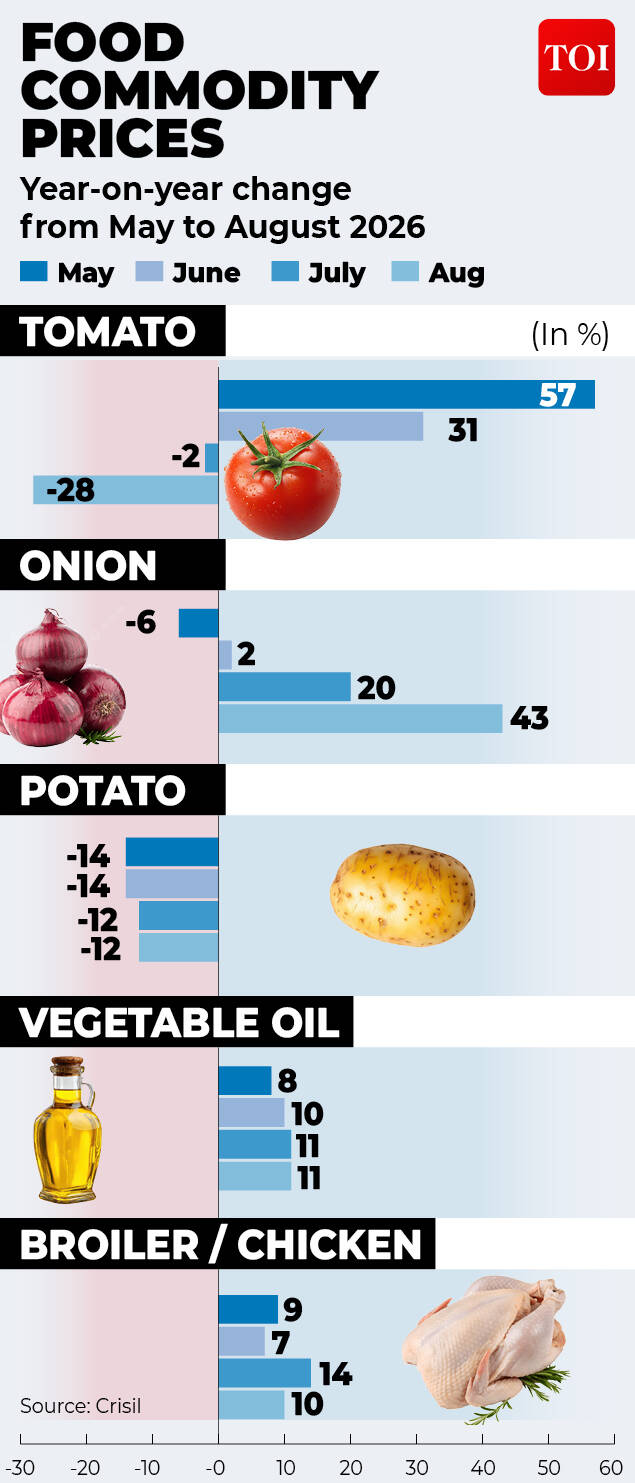
Vegetables were among the key drivers of the higher food bill in August, with onions emerging as the biggest pain point.According to the Crisil Roti Rice Rate report, onion prices surged about 43% year-on-year to Rs 40/kg, from Rs 28/kg a year earlier, as unseasonal rain and hailstorms damaged the late-season crop and stored inventories in Maharashtra. Rabi onion production also fell 5-6%, further tightening supplies.There was some relief elsewhere in the vegetable basket. Potato prices fell 12% and tomato prices dropped 28% year-on-year, helped by higher potato production and increased tomato arrivals.But these savings were offset by costlier essentials. Vegetable oil prices rose 11% and LPG cylinder prices 10% year-on-year, adding to the cost of cooking at home, while supply disruptions and elevated energy costs amid the West Asia conflict added further pressure.Rice also remained among the factors keeping meal costs elevated.
Even the global food market is turning less friendly
The pressure is not confined to India.The FAO Sugar Price Index jumped 11.9% in August from July, the sharpest monthly increase among the major food commodity groups tracked by the UN food agency.FAO attributed the increase to expectations of lower sugar-beet yields in the European Union because of adverse weather, concerns over El Niño’s impact on production in key Asian producers, lower Brazilian sugar production and India’s announcement of duty-free raw sugar imports.The broader FAO Food Price Index rose 1.9% in August from July to 133.3 points, and was 2.5% higher than a year earlier. The cereal index rose 2.2%, the dairy index 2.3%, the vegetable oil index 1.1% and the meat index 1%.Global wheat prices rose 2.6% during August and were 15% higher than a year earlier. Hot and dry weather in Europe, weaker production prospects and disruptions to Black Sea export logistics have added to the pressure.FAO has forecast global cereal production at 2,980 million tonnes in 2026, down 2% from 2025, although it would still be the second-largest harvest on record.For India, that means international food prices remain an important risk even when domestic production and stocks appear comfortable.
Crude oil is another problem brewing
There is another pressure point that could feed into household costs indirectly: crude oil.India’s average crude oil import basket crossed the $100-a-barrel mark last Friday for the first time in six weeks, as hostilities in West Asia intensified and concerns over supplies through the Strait of Hormuz increased.The Indian crude basket rose to $101.07 a barrel on Friday, its highest level since July 23, according to Petroleum Planning and Analysis Cell data.The September average so far is around $99.38 a barrel, compared with $90.19 in August.International fuel prices have risen alongside crude. The average free-on-board price of diesel was $156.88 a barrel in September, up from $149.35 in August, while petrol averaged $122.12, compared with $110.87 in August.For oil marketing companies, prolonged high crude prices could mean higher under-recoveries if retail pump prices remain unchanged.During the peak of the conflict in May, when the Indian crude basket averaged more than $110 a barrel, oil retailers were reportedly making under-recoveries of more than Rs 1,000 crore a day.
ICRA has warned that renewed Iran-US hostilities could put additional pressure on the limited crude supplies moving through the Strait of Hormuz. Any sustained disruption could keep international oil prices elevated.Higher crude prices matter for food in several ways, from transport and logistics to packaging and manufacturing costs.
Inflation may rise even as GDP stays strong
All of this raises a bigger question: can strong GDP growth coexist with an uncomfortable household budget?The answer, at least for now, appears to be yes.Retail inflation is expected to rise to 4.88% in August, with food inflation climbing to 6.03%, even as easing vegetable prices offer limited relief.Sugar prices are estimated to have risen around 15% in August, with sugar inflation expected to jump 11.53% month-on-month. Cereal inflation could rise to 2.2%, while pulses inflation is expected at 2.7%. Milk prices may also remain under pressure following recent retail price hikes.The finance ministry’s assessment showed food inflation had already risen to 5.52% in July from 5.32% in June, driven partly by protein-rich foods and processed-food categories.This creates a disconnect between the broader economy and the household kitchen.India’s 7.8% GDP growth points to robust economic activity, while record forex reserves and comfortable foodgrain stocks give the government a cushion to respond to supply shocks. As of May 28, the Central Pool held 513 lakh tonnes of wheat and 397 lakh tonnes of rice, well above buffer norms.But these strengths cannot prevent every price shock.Sugar, edible oils, milk and onions remain vulnerable to supply and global price pressures. For consumers, the impact may come through higher prices or smaller packs.