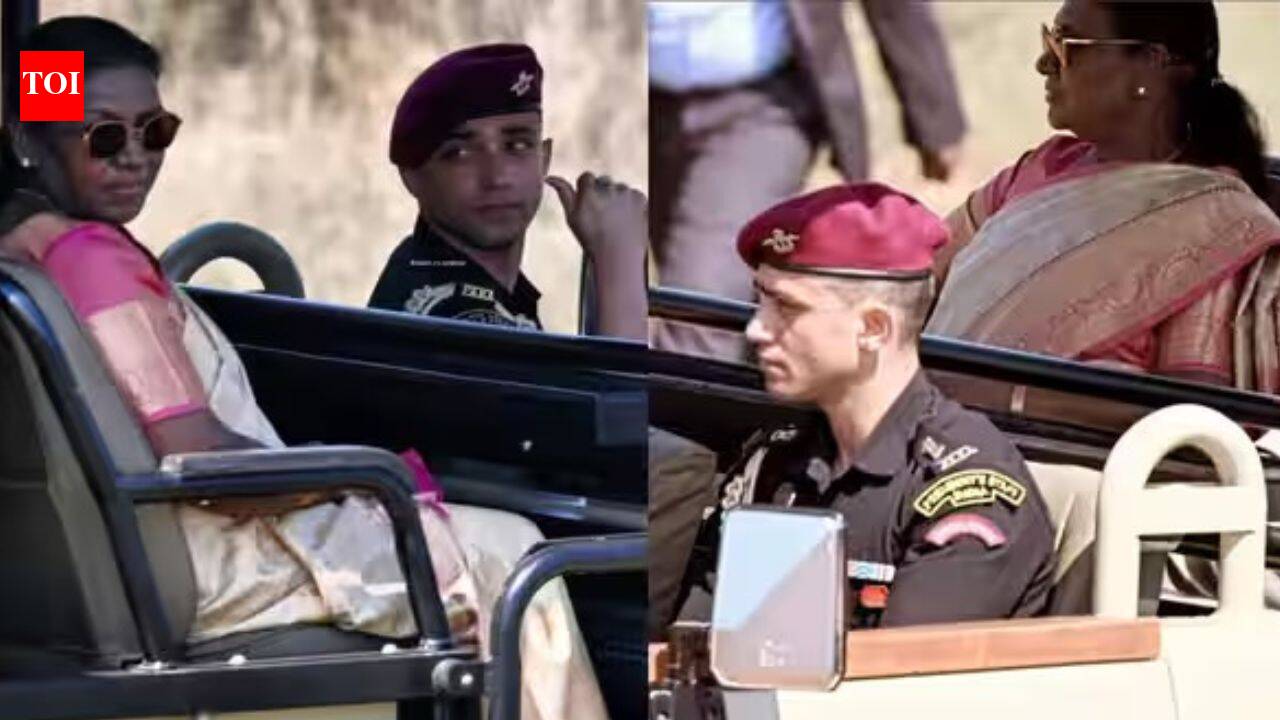

To the public, an Aide-de-Camp (ADC) is often seen as the military officer walking a few steps behind the President at important ceremonies, state visits and official events. But the role goes far beyond appearances. An ADC works closely with the President, coordinates official requirements and remains constantly alert to what is happening around the head of state.Former President Droupadi Murmu’s ADC, Major Rishabh Singh Sambyal, recently offered a rare glimpse into the training and mindset required for the job during his conversation with Raj Shamani on the Figuring Out podcast. Having served as the President’s ADC for around three years, Sambyal explained why observation and anticipation are such important parts of the assignment.
What is a President’s ADC trained to notice?
Sambyal suggests that the training is not simply about reacting once something goes wrong. Officers are trained to develop the ability to observe their surroundings even when they are physically exhausted.He described exercises during his military training in which officers were deliberately pushed to their limits. According to Sambyal, trainees could be carrying around 70 to 80 kg and be deprived of food, water and sleep for extended periods. Even under those conditions, they were expected to remain observant.He gave an example of an observation exercise in which objects would be deliberately placed along a route. A trainee might pass a helmet hidden behind a tree without consciously registering it. Later, the trainee would be questioned about what they had seen.“While you’re doing this, in between random places, there are things kept. Say, for example, we keep a helmet behind a tree, and when that finishes, there’s a test: what did you observe? That is how we train,” Sambyal said.The purpose, he explained, is to ensure that an officer can continue registering details in the surroundings even when tired, hungry or sleep-deprived. That ability becomes particularly important when working close to a high-value protectee such as the President.
What if the President is actually in danger?
Sambyal did not describe a specific emergency response plan or reveal operational details about what an ADC would do during an actual attack. Such protection arrangements involve specialised security agencies and multiple layers of personnel.What his interview does reveal is the level of awareness expected from an ADC before a situation reaches that point.The officer is expected to remain aware of the environment, anticipate requirements and notice things that may not immediately attract the attention of others. The ADC also works within a broader security and protocol arrangement rather than functioning as the President’s only protection.Sambyal said that security precautions can extend beyond the immediate space around the President. He told Raj Shamani that, to his knowledge, an area around the President can be sanitised during certain movements, with weapons, metal objects and other potentially dangerous material kept away. Outlook also reported his comments about the extensive precautions taken around the President.This is why even apparently ordinary interactions can be subject to strict protocol.
Why can’t everyone simply approach the President?
One of the points Sambyal discussed was why people are not ordinarily allowed unrestricted physical contact with the President.Explaining the reasoning behind the protocol, he said that security personnel cannot know the intentions of every individual approaching the head of state.“You don’t know the intentions of the individual,” he said. “How can you trust the person who is on the other side?” He also pointed out that caution extends to seemingly routine details. Speaking about something as ordinary as the President’s drinking water, Sambyal questioned how security personnel could automatically know who had placed it there or what it might contain.The point was not that every person or object represents a threat, but that presidential security is built around eliminating avoidable risks rather than assuming that nothing will go wrong.
The ADC’s job is much more than standing beside the President
The ADC also has an important coordination and protocol role.Sambyal described the responsibility simply as “Everything”, explaining that he had to look after presidential requirements, whether official or unofficial.For example, if President Murmu wanted to speak to the Prime Minister, she could inform the ADC, who would then coordinate with the relevant people so that the communication could take place. The role therefore involves communication, coordination, protocol, scheduling and anticipating what the President may require during official engagements.The most revealing part of Sambyal’s account is perhaps the observation training.An officer accompanying the President cannot afford to become so accustomed to a familiar setting that unusual details go unnoticed. The training he described is designed to build exactly the opposite habit: constantly registering the environment.That does not mean an ADC is expected to independently identify every possible threat or replace specialised security personnel. Instead, the officer is one more trained set of eyes close to the President, working within a much larger protection system.The ability to spot something unusual, communicate it quickly and remain composed under pressure can become crucial in a high-stakes environment.
Sambyal’s three years with President Murmu
Sambyal served as President Murmu’s ADC for around three years before leaving the Army after approximately 12 years of service. His time at Rashtrapati Bhavan also gave him a close personal association with the President.In his conversation with Raj Shamani, he recalled that his first meeting with Murmu felt like seeing his mother. He said his military career had kept him away from his own mother for long periods, and he found the President’s warmth and homely nature deeply familiar.His tenure as ADC eventually became widely visible on social media, where photographs and videos of him accompanying President Murmu at official events attracted considerable attention. He has since taken premature retirement from the Army after around 12 years of service.His recent interview, however, offers a different perspective on the uniformed officer often seen standing quietly beside the President. Behind that composed appearance is a job built around discipline, anticipation, coordination and an unusually high level of situational awareness.Why shaking hands or touching the President’s feet can pose a security riskFormer ADC Rishabh Sambyal opened up about why even seemingly simple gestures such as shaking hands or touching the President’s feet are not taken lightly from a security perspective. He explained that the security team cannot know a person’s intentions with absolute certainty, saying, “You shake hands. You don’t know the intentions of the individual. Okay, for example, I don’t like you. I come here, I shake your hand, I have something in my hands, I have to press, or I give you a slap. I will go in jail. That is the best, kya hoga? But the image of the President is destroyed. How can you trust a person who’s on the other side? You can’t trust. I know they want to do it, but you can’t trust them. You’re not 100% sure.”Why the security team looks at everyone with the same level of cautionSambyal also opened up about the mindset required while protecting the President, explaining that security personnel cannot afford to assume that everyone approaching the President has harmless intentions. “Yes. We have to. Like everyone is a bad person. Other than the people, government officials and senior people, but as a whom I don’t know personally, we look at the same way. Every human, we look at the same way,” he said.People meeting the President are briefed beforehandExplaining how security teams prepare even for interactions with people who have been granted an appointment, Sambyal said that those meeting the President are briefed and closely observed. “Even if when you come for the President, we will brief you and I will be standing when you meet the President so that suddenly you don’t come out of emotions, ab oh, I want to do this now. Everyone is recording me, I’m on the national TV, I’ll do something. Just for that one moment. Just for one moment. A lot of people would be like that. Anyone can do that.”The team prepares for the possibility that something could go wrongSambyal explained that the security detail operates with the possibility that an unexpected situation can arise at any moment. “I can’t trust anyone. Nobody. You can’t trust the human emotional outburst or their mindset. Kya hoga? Psychopath. Just psychopath, you just mentioned. So we look at everyone with the same eyes, that anything can go wrong. We are always prepared ki yahan galat hona hi hai. So we work accordingly, so that nothing goes wrong when the President is out.”Why even the President’s glass of water is carefully checkedSambyal revealed that security precautions extend to details that most people would never think twice about, including the glass from which the President drinks water. “You don’t know who has kept it there. You don’t know something is on the glass or not.”Food served to the President also goes through a security procedureOpening up about the precautions surrounding the President’s meals, Sambyal said that food is subject to its own security protocol. “So there’s a security procedure in eating also. What meals will be included, what in the meals, what, you know, like the spices they will be using, whatever, it’s being prepared for the President. There’s a responsibility of someone who checks it and then gives an okay ki haan, now it’s okay. She is good to have it.”A chef travels ahead when the President eats outsideSambyal further explained that these precautions continue even when the President is eating at a banquet or an event outside. “The food which is prepared for the President is categorically, like, made for the President. Even in a banquet, we send a chef in advance. The chef of the President goes there and tells ki achha, do this, do that, don’t do that. Okay. It might affect her. You don’t want to make the President uncomfortable. It’s their responsibility.”Anyone can request an appointment with the President, but requests are filteredSambyal also explained how requests from people seeking to meet the President are handled. “Anyone in the country can request to meet the President. The request is sent on an official email ID. The staff of the Honorable President vets it out and then discusses it with the President.”The President’s time and meetings are carefully prioritisedSpeaking about how appointments are decided, Sambyal said the sheer number of requests makes a filtering process necessary. “Because now it’s a big country. There are a lot of people in the country. You cannot meet everyone. It’s her personal time also. She’s working also. So she segregates. Filters are put in place. What is important. If there’s a reason, we give priority to them.”Access to the President’s private cabin is restrictedSambyal also clarified that meetings with the President are generally conducted in designated appointment spaces, while access to her private cabin is restricted. “Yes, there’s an appointment room. In the private cabin, are people allowed? Yes, the staff of the President. Only the staff.”Disclaimer: This article is based on statements attributed to Major Rishabh Singh Sambyal during his conversation with Raj Shamani and publicly available information about the role of the President’s ADC. Operational details of presidential security are not publicly disclosed and should not be inferred from the interview.