

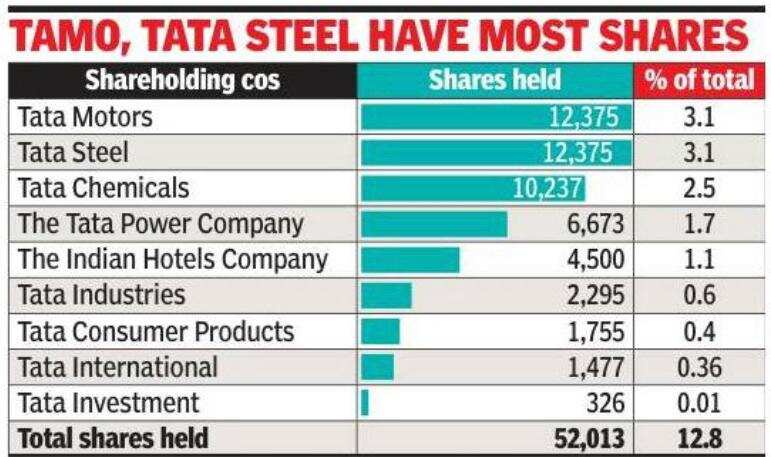
MUMBAI: Nine Tata companies — seven listed, two unlisted — hold 12.83% of Tata Sons. The listed companies alone account for 11.9%. They have held these stakes for three decades, treated as dead capital, with no exit and no public valuation. That changes if Tata Sons lists, as required under Reserve Bank of India rules for upper-layer investment companies.The companies could cash in on their Tata Sons stakes through the IPO — turning an illiquid asset liquid — and re-rate the listed entities’ stock prices in the process.The seven listed holders: Tata Steel and Tata Motors each hold 3.06% of Tata Sons. Tata Chemicals holds 2.53%, Tata Power 1.65%, Indian Hotels 1.11%, Tata Consumer Products 0.43% and Tata Investment Corporation 0.08%. Two unlisted Tata companies hold the remaining 0.93%.At Tata Sons’ estimated market value of a minimum of Rs 10 lakh crore, the Tata Steel and Tata Motors stakes are each worth Rs 30,600 crore — 13% and 28% of their respective market caps.Tata Chemicals stands out — the value of its Tata Sons stake is more than its own m-cap.Spark Capital estimated in March 2024 that the stake was worth about 80% of Tata Chemicals’ market cap. As of Friday, that market cap stood at Rs 15,594 crore. At the same valuation of Rs 10 lakh crore, Tata Chemicals’ stake is worth Rs 25,300 crore — well above the company’s own market cap, and the clearest listed proxy for any value an IPO would unlock.
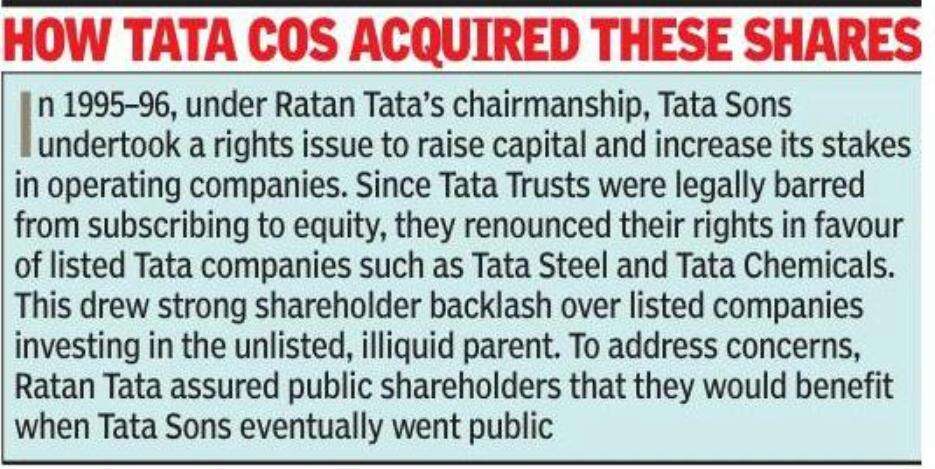
Shriram Subramanian, founder of InGovern Research Services, which published a 2026 report backing a Tata Sons listing, said an IPO would give more than 1.2 crore public shareholders in listed Tata companies a long-awaited avenue for value unlocking, and give the seven listed companies liquidity. All seven stocks could see a big boost when trading opens Tuesday, with Tata Chemicals gaining the most.The seven listed Tata companies bought into Tata Sons via a 1995-96 rights issue. Tata Trusts, the promoter, did not subscribe because law barred charitable trusts from investing in commercial entities.Shareholders had objected at the time, saying listed companies should not sink capital into an unlisted, illiquid parent. Ratan Tata, then Tata Sons chairman, had replied that the investment would pay off once Tata Sons went public. Former Tata director Nusli Wadia had argued the cross-holdings served only to bolster Tata Trusts’ voting power in Tata Sons.
That 1995-96 transaction has come back to bite Tata Sons. RBI classified NBFCs into an upper layer partly based on indirect public-fund access through group companies. Tata Sons falls into that category — and the listing requirement followed.A Tata Sons IPO would finally bring market-driven price discovery to its shares, replacing private assessments. In 2020, during its legal battle with Cyrus Mistry, its late former chairman, Tata Sons cited an assessment by chartered accountant Y H Malegam valuing the company at Rs 3.8-4.3 lakh crore. Mistry disputed the figure, saying his own calculations put the value at more than double.That figure would look different today. Tata Sons’ portfolio has changed materially since 2020 — Tata Electronics has emerged as a bright spot, Air India remains loss-making, and the market value of its listed holdings has risen sharply, though TCS has come under pressure recently amid AI concerns.An analyst noted a caveat: while the market applies a holding-company discount to Tata Sons, valued at a minimum of Rs 10 lakh crore, Tata Investment — itself a holding company — has historically traded at a premium to its underlying investments, rather than a discount.