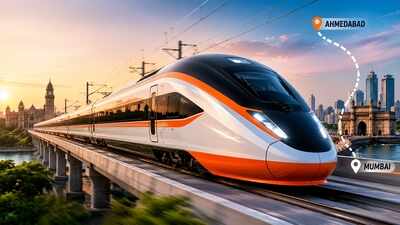
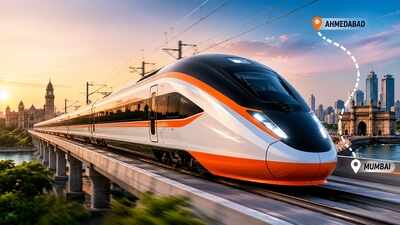
Even as it builds the country’s first high-speed train set for the first time, Indian Railways has already set the ball rolling for another set of bullet trains that will run at 350 kmph.India is planning to develop and manufacture its own high-speed, or bullet, trains with a design speed of 350 kmph, known as B35, by 2030, according to this TOI report.This would put the indigenous trains on par with Japan’s next-generation E10 series, which is also scheduled to enter production in the same year, the report said.The entire 508-km Mumbai-Ahmedabad High-Speed Rail corridor is scheduled to be completed by December 2030. But to begin with a small stretch will likely be thrown open in 2027 for which BEML is manufacturing the high-speed train sets that will have a design speed of 280 kmph.Also Read | How Vande Bharat Express marked a tech leap for railways after Rajdhani & Shatabdi. Next stop: Bullet trainsThe Mumbai-Ahmedabad corridor will initially run B28 trains Their maximum operating speed, however, will be “249 kmph”. BEML has already secured contracts to manufacture 32 B28 trains.Two prototype B28 trains are expected to be ready for trial runs in the first quarter of 2027. BEML said in a filing with the BSE on Friday that it had also received a separate contract worth Rs 5,400 crore for manufacturing another 15 B28 trains.
India’s 350 kmph bullet train dream
The details are part of the railway ministry’s Cabinet proposal seeking approval for the revised cost of the Mumbai-Ahmedabad High-Speed Rail (MAHSR) project.The Cabinet has approved a revised project cost of more than Rs 2 lakh crore, almost twice the estimate prepared in 2015. Of the nearly Rs 1 lakh crore increase in the project cost, the additional expenditure will be met through budgetary support.TOI has learnt that the railway ministry told the Cabinet it had begun work on developing B35 trains after Japan communicated in December 2024 that production of its existing E5 series trains was being phased out. Japan indicated that manufacturing of the E10 series would start in 2030, with the trains expected to be ready for operations by 2034.Officials said the possibility of deploying E10 trains would be examined once they become available.The ministry has also said that work on indigenous B28 high-speed trains has already been taken up. Alongside this, India will develop its own Bharat Train Control System (BTCS).
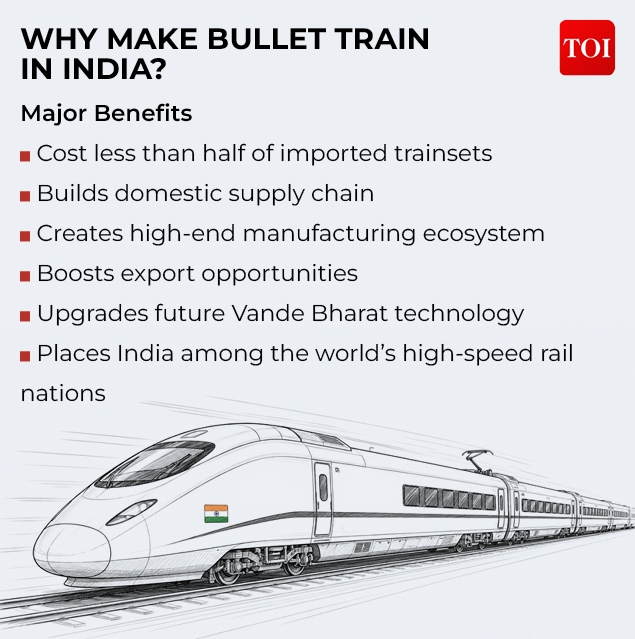
Why make bullet trains in India?
The proposed system follows the approach adopted by China with its indigenous CTCS signalling and train control system, which is used to manage train speeds, spacing and safety across both conventional and high-speed railway networks.According to the ministry, the project cost has risen sharply from the earlier estimate of Rs 1.1 lakh crore. A major part of the increase has come from land acquisition, whose cost has more than tripled to around Rs 19,700 crore.Infrastructure expenditure has climbed by nearly 50% to more than Rs 1 lakh crore, while spending on trains and signalling systems has increased by around 100% compared with the estimate made in 2015.Excluding the cost of future Japanese trains, the project now works out to approximately Rs 399 crore per km.
B28 bullet train project
The bullet trains will feature fully air-conditioned chair-car coaches along with world-class passenger facilities. They will also be equipped with advanced onboard infotainment systems, reclining and rotatable seats and dedicated facilities for divyangjans.BEML has set up a dedicated ‘Aditya’ High-Speed Rail Complex in Bengaluru for manufacturing the bullet trains.These high-speed trains will be manufactured using advanced, precision-driven technologies. Bullet trains operating in countries such as Japan and those in Europe are generally designed to function in cold-weather conditions. For the Indian trains, however, the design and manufacturing process will factor in the country’s heat and dust conditions.Experts have described the project as a significant engineering step for India. Manufacturing a high-speed bullet train requires a substantially different set of capabilities from those needed to produce the LHB coaches that Indian Railways currently manufactures.In simple terms, developing a bullet train involves much more than making a train capable of travelling at higher speeds. It must be engineered to remain stable and deliver a smooth ride at those speeds.The body needs to combine strength with low weight, while the wheels and suspension systems have to support a stable and comfortable journey. Train control technology also needs to be significantly more advanced to ensure safe operation and maintain passenger comfort during sudden changes in air pressure.The Mumbai-Ahmedabad bullet train is one among several high-speed rail projects being planned by Indian Railways. The Budget this year announced seven additional high-speed rail corridors. Building domestic bullet train manufacturing capabilities could help meet the rolling stock requirements of these corridors in a cost-effective manner.The proposed routes are Mumbai-Pune, with a travel time of 48 minutes; Pune-Hyderabad, 1 hour 55 minutes; Hyderabad-Bengaluru, 2 hours; Hyderabad-Chennai, 2 hours 55 minutes; Chennai-Bengaluru, 1 hour 13 minutes; Delhi-Varanasi, 3 hours 50 minutes; and Varanasi-Siliguri via Patna, 2 hours 55 minutes.(With inputs from Dipak K Dash)