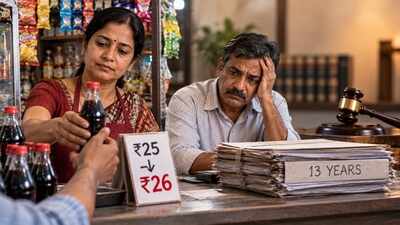
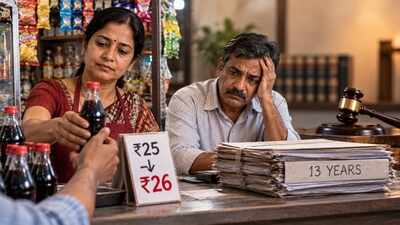
A man working in his wife’s shop faced a thirteen year criminal case for the sale of a cold drink above the maximum retail price. The Bombay High Court has now brought an end to a criminal case that had continued for 13 years against the man.The court has quashed the prosecution, which arose from an allegation that the man had sold a 600-ml bottle of cold drink for Rs 26 even though its MRP was Rs 25.The allegation concerned an overcharge of Re 1. The man was working at his wife’s shop when the incident took place.
What the case is about
The case originated from an inspection carried out on March 29, 2013, by the Inspector of Legal Metrology at the man’s flour mill and his wife’s shop.During the inspection of the shop, the inspector purchased a 600-ml cold drink bottle carrying an MRP of Rs 25. The man allegedly charged Rs 26 for the bottle and issued a bill showing the same amount.The Legal Metrology Inspector subsequently reported the incident to the Assistant Controller of Legal Metrology in a letter dated July 15, 2013. The letter set out what had allegedly taken place during the inspection of the man’s wife’s shop on March 29.On the basis of the inspector’s report, the government filed a complaint before the Judicial Magistrate First Class, Lanja.The magistrate then ordered criminal proceedings against the man on July 24, 2013. He was accused of violating Rule 18(2) read with Rule 32(2) of The Legal Metrology (Packaged Commodities) Rules, 2011, in Case No. 121 of 2013.The man challenged the proceedings before the Ratnagiri sessions court through Revision Application No. 25 of 2013. However, the sessions court rejected his challenge on September 18, 2014, leaving the criminal prosecution against him intact, according to an ET report.He subsequently approached the Bombay High Court.The man told the court that the inspector had initially visited his flour mill and allegedly demanded a bribe of Rs 5,000 from him in return for allowing him to continue operating the mill. According to the man, he refused to pay the money.He further alleged that after he declined to pay the bribe, the inspector threatened him and made him sign an authority letter. The man said he did not understand the contents of the document because it was written in English.The dispute remained before the courts for years until the Bombay High Court finally intervened.On June 29, 2026, the court quashed the criminal prosecution against the man, bringing the 13-year-old case arising from the Re 1 cold drink bottle overcharge to an end.
Why did the man win the case?
Anuj Dave, Practice Head (Ahmedabad & Mumbai), Clavius Legal, told ET that the central reason the man succeeded was that the prosecution had proceeded against the wrong individual.The records relied upon by the prosecution itself showed that the cold drink bottle had been sold by the man’s wife, who owned and operated the shop. The man’s role, according to those records, was limited to preparing the bill on his wife’s instructions after the sale had taken place.Dave said the high court drew a distinction between preparing an invoice and actually carrying out a sale. In his view, the provision dealing with overcharging applies to the person who sells the product, rather than someone who merely prepares the bill after the transaction. Since the man was not the person who made the sale, the prosecution against him could not be sustained.The high court described the prosecution as “misconceived and misdirected”. It also noted that the date appearing on the bill had been altered, with March changed to June, which further cast doubt on the prosecution’s case.Dave says: “This ruling does not mean shops can now charge above MRP that remains an offence. All the court clarified is that the person prosecuted must be the one who actually made the sale. Here the shop was the wife’s and the sale was hers; the husband had only written the bill afterwards. You cannot fasten criminal liability on someone simply because he is related to the seller or happened to hand over an invoice.”The judge said: “In my opinion the overwriting even otherwise makes the entire case doubtful.”The court also examined the contents of the Legal Metrology Inspector’s letter dated July 15, 2013. The letter stated that the incident had occurred on March 29, 2013 at the shop belonging to the man’s wife, where she was engaged in selling various items.Importantly, the high court noted that the inspector’s own account recorded that the cold drink bottle had been sold by the man’s wife from her shop.The court therefore found that the material on record showed the wife had actually made the sale, while the husband had prepared the bill at her direction.On examining the inspector’s letter, the court said it was apparent that the transaction had been carried out by the wife. Despite this, the complaint named only the man. His wife was neither accused of any offence nor were proceedings initiated against her.The high court also considered Rule 18(2) of the Legal Metrology (Packaged Commodities) Rules, 2011. The provision states that a retail dealer or any other person, including a manufacturer, packer, importer or wholesale dealer, cannot sell a packaged commodity at a price higher than its retail sale price.The court noted that Rule 18(2) applies to the retail dealer or other person who actually makes the sale. In the circumstances of this case, the person who made the sale was Narvekar’s wife.The high court then considered the definition of “sale” under Section 2(r) of the Legal Metrology Act, 2009.The high court found that the prosecution itself was misconceived because the man was not the shop owner and had not actually made the sale. According to the court, he had only prepared the bill, while the transaction was carried out by his wife, who owned the shop.The court also held that preparing a bill on the instructions of the shop owner could not, by itself, be treated as a “sale” within the meaning of Section 2(r) of the Legal Metrology Act, 2009.
What about the shop owner?
The judgment does not automatically result in any action against the man’s wife. Dave said the high court did not determine whether she had herself violated the law. Its finding was limited to the fact that the man had been wrongly prosecuted. The court also noted that his wife had never been made an accused in the case.In principle, the authorities could examine the conduct of the person who actually carried out the sale. However, the transaction in question took place back in 2013.Dave says: “A fresh case now would run straight into limitation. This is a fine-only offence with only a short window to prosecute apart from the fact that it is a minor, compoundable matter carrying a fine of just Rs 2,000. In practice, fresh action this long after the event is very unlikely.”