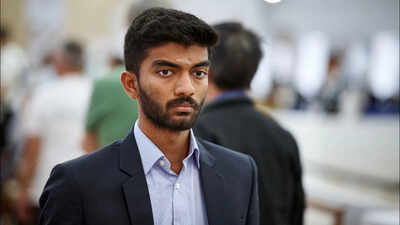
NEW DELHI: Since becoming world champion two years ago, noise has followed Dommaraju Gukesh almost everywhere, at times making it feel as though he isn’t worthy of the title he rightfully won.But on Friday, when India needed the youngest world champion in history to deliver a win, he did exactly that, turning around an almost-lost position to beat Germany’s Alexander Donchenko in Round 9 of the 46th Chess Olympiad in Samarkand, Uzbekistan.It was the kind of performance that felt like it could quiet the criticism all on its own.
How Gukesh turned the tables on Donchenko
Playing black, Gukesh traded off his dark-squared bishop early to damage White’s pawn structure, then spent the middlegame manoeuvring patiently, repositioning knights, expanding on the queenside with a5-a4, and probing for weaknesses without rushing.For a long stretch, the position stayed murky and roughly balanced, with both sides shuffling pieces and neither able to land a clean blow.It was in the run-up to the time control that things turned dangerous for Gukesh. Donchenko doubled his rooks on the e-file and pushed one all the way to e6, aiming squarely at Black’s king, which had been forced to step out to f7 for safety.With his own clock running low, Gukesh had to defend precisely while trying to generate counterplay of his own on the kingside, pushing his h- and g-pawns forward to create complications. It was a position where one careless move could have ended the game in White’s favour.Gukesh held his nerve. As the pawn storms and piece trades settled down, he found a route to activate his queen and knight while White’s pieces drifted out of coordination.The decisive moment came when Donchenko’s bishop was left hanging on c3; Gukesh’s queen swooped in to capture it, and from there it was a matter of technique.A check with his queen forced Donchenko’s king into an impossible spot, and White resigned rather than play on a piece down with his king exposed.Elsewhere on the board, Nihal Sarin, playing white, spent much of his game in some turmoil against Frederik Svane but held firm for a draw.With Gukesh’s win already banked, Praggnanandhaa and Arjun Erigaisi didn’t need to force matters either, settling for draws against Vincent Keymer and Matthias Bluebaum, respectively. India closed out the match 2.5-1.5.With the win, India moved to 15 points, still one point behind hosts Uzbekistan, who beat the United States on Friday to stay in front.
Vantika, Divya lead India’s women to victory
India’s women’s team also had a productive Friday, with Vantika Agrawal and Divya Deshmukh both delivering important wins to seal the match against Uzbekistan.Vantika, playing white against Nilufarkhon Imomkuzieva, picked up an early pawn with a sharp tactical sequence; a check with her queen forced Black’s king to give up material before the middlegame had properly begun.She nursed that small material edge through a long, technical battle, trading down into a rook endgame where her extra pawn and more active king proved decisive.Pushing her kingside pawns forward in the closing stages, Vantika eventually broke through, and Imomkuzieva had no way to hold the position together.Divya Deshmukh’s game against Gulrukhbegim Tokhirjonova was a far longer and more chaotic affair.
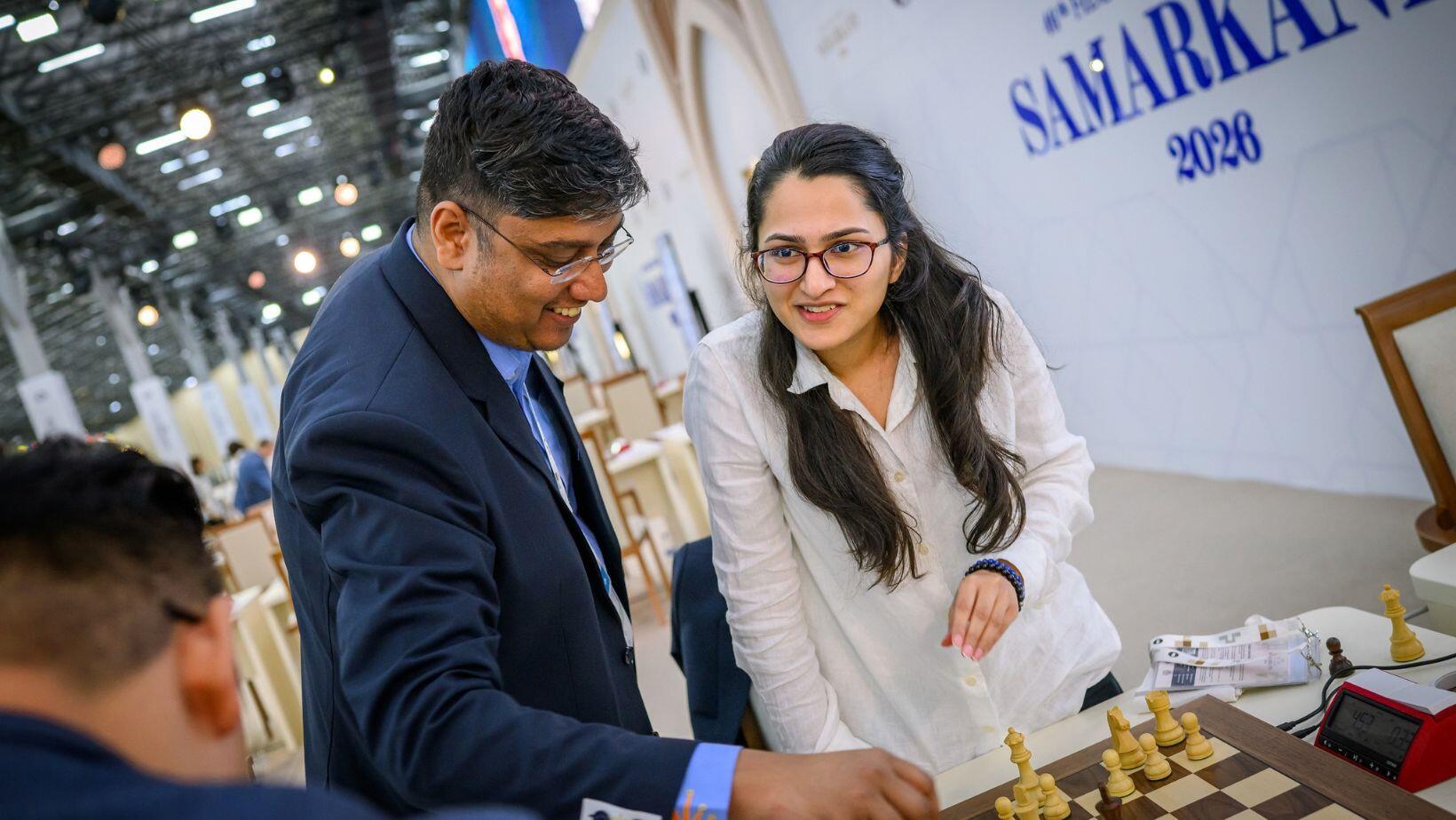
Both sides grabbed material early. Tokhirjonova’s knight snatched a pawn on b7 just as Divya’s queen picked up a stray piece on d2, leaving the position roughly balanced but sharp.What followed was a marathon battle through the middlegame and into a complex rook, knight and bishop endgame, with both players navigating tricky technical positions deep into the game.Divya’s technique held up better over the long haul, and after 73 hard-fought moves, Tokhirjonova had nothing left to stop Black’s advancing king, resigning the position.Those two results were enough to see India through the match, keeping the team firmly in the mix for a medal.As things stand, India’s women sit second in the standings on 15 points, behind an in-form Chinese side on 17.With two rounds left, India’s hopes of gold now depend largely on whether China slip up, but on Friday’s evidence, neither Indian team looks inclined to make things easy for anyone chasing them either.