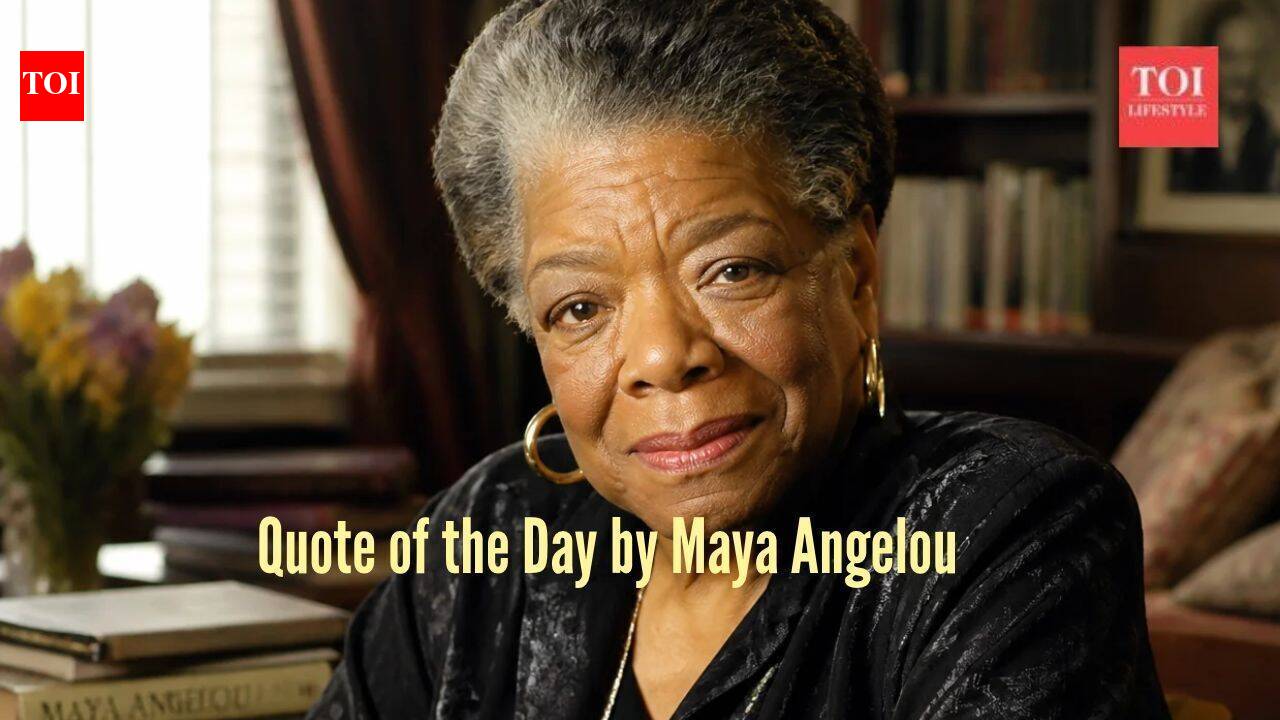
Maya Angelou is one of America’s most iconic poetic voices. A writer and a civil rights activist, she was a woman who turned personal pain into powerful words. Her life was a wonderful journey of resilience, self-discovery and determination. Through poetry, autobiographies, speeches and activism she became one of the most influential literary voices of the 20th century.Born Marguerite Annie Johnson on April 4, 1928, in St. Louis, Missouri, United States, Maya Angelou grew up in an era of deep racial segregation and discrimination in American society. When she was very young, her parents separated and she and her older brother, Bailey, were sent to live with their paternal grandmother in Stamps, Arkansas. She grew up in the racially segregated American South, meaning that she knew the harsh realities of racism from an early age. She saw the discrimination, inequality and humiliation that was routine for African Americans.She also had a very traumatic experience in her childhood. Her mother’s boyfriend sexually abused her when she was seven. She told of the abuse and the man was killed. Young Maya thought that her words had killed the man. She was so full of guilt and fear she did not speak for almost five years. She retreated into herself during this time and sought refuge in books and literature. A family friend of her grandmother’s, Mrs Bertha Flowers was key to helping her find her voice again. She pushed Maya to read poetry aloud, and introduced her to some of the greatest writers and poets. Little by little, literature became her refuge, words her means of finding her voice again, someday.Angelou’s early life was anything but ordinary. She held a variety of jobs, including cook, waitress and streetcar conductor. She was one of the first African American women streetcar conductors in San Francisco at 16. At a young age she also became a mother, giving birth to her son Guy at 17. Motherhood and the hard work of earning a living did not prevent her from pursuing her interests in music, dance, theatre and writing.In the 1950s she travelled widely as a singer and entertainer, touring Europe with a production of the opera Porgy and Bess. She also performed in clubs and made a record. These experiences also exposed her to different cultures and broadened her world view. Her artistic interests eventually led to writing and activism, two fields in which she would leave an extraordinary legacy.The civil rights movement was a defining moment in Angelou’s life. She joined the fight for racial equality, working with prominent leaders and organisations, including the Southern Christian Leadership Conference. She also spent some time in Ghana in the early 1960s, meeting African intellectuals, artists and activists. Her time in Africa helped her realise more about identity, race, history and belonging.She had her literary breakthrough in 1969 with the publication of her autobiographical book, I Know Why the Caged Bird Sings. The book became an international bestseller and cemented Angelou’s place as a major literary figure. It was also ground-breaking because it put the experiences of a black girl at the center of American literature, when those stories were rarely given mainstream recognition.Angelou went on to pen several autobiographies such as “Gather Together in My Name,” “Singin’ and Swingin’ and Gettin’ Merry Like Christmas,” “The Heart of a Woman,” and “All God’s Children Need Travelling Shoes.” These books together gave a stirring account of her own personal development and the social changes taking place around her.Her poetry was just as influential. She wrote about dignity, identity, freedom, womanhood, racial pride, love and the human ability to overcome adversity.Angelou’s contribution was much larger than literature. She recited On the Pulse of Morning at President Bill Clinton’s inauguration in 1993, the first African American woman to do so at a U.S. presidential inauguration.Over the years, Angelou received many awards for her literary and cultural achievements, including the Presidential Medal of Freedom in 2011, awarded by President Barack Obama. She won multiple Grammy Awards for her spoken-word recordings and was nominated for a Pulitzer Prize for her poetry collection Just Give Me a Cool Drink of Water ‘fore I Diiie.Maya Angelou died at her home in Winston-Salem, North Carolina, on May 28, 2014, at the age of 86. But her influence continues to grow. Her books are studied in schools and universities, her poems are quoted worldwide and her speeches still inspire people dealing with discrimination, self-doubt and personal struggles.Her greatest contribution might not have been that she wrote about suffering, but that she showed how suffering doesn’t have to shape a person’s future. She proved that your past doesn’t have to dictate your possibilities. Her life was an example of courage, education, creativity and self-belief in enabling an individual to rise above even the most difficult of circumstances.Angelou was a voice for those who had been muted for so long, especially women and African Americans.Quote of the DayPeople will forget what you said, people will forget what you did, but people will never forget how you made them feel.” These lines by Maya Angelou are profound.These words that are often attributed to Maya Angelou have a deep message about human relationships and the lasting influence of our behaviour. The quote reminds us that people may forget words and actions as time passes, but the feelings we create in others often stay with them for years. It’s a great lesson in empathy, kindness and how we treat people.”Think about the people you’ve encountered. You probably won’t remember every conversation you’ve had with a teacher, colleague, friend or family member. You might have forgotten the actual advice they gave you or the details of something that they did for you. But you probably remember the teacher who believed in you when you didn’t, the friend who stuck with you through a tough time, or the colleague who made you feel valued when everyone else ignored your contribution. Perhaps the words or actions have long since faded into distant memories, but the emotions associated with those experiences persist.This is because human relationships are not just about conversations or gestures; they are about the feelings people have in the presence of each other. Someone who listens nonjudgmentally can create safety for another. Someone is acknowledged with a small token of appreciation. A few kind words at the right time can bring back a man’s confidence. Similarly, a careless word, an act of humiliation or a dismissive attitude can leave emotional scars long after the incident itself is forgotten.For example, a manager might want to give feedback to improve an employee’s performance, but if the feedback is given in the form of public criticism or humiliation, the employee may remember the embarrassment rather than the advice. However, the same feedback can motivate someone to do better if it is delivered with sensitivity and encouragement.This is especially true in our everyday relationships. Parents forget the little things they say to their children but children often carry the emotional impact of those words into their adult lives. A child who is told that they are capable, loved and valued builds a completely different sense of self-worth than one who is always being criticised or compared to others. Likewise in friendships and marriages, it is often the small daily acts of consideration, understanding and emotional support that strengthen relationships.Angelou’s message also contains a vital lesson for leadership. People don’t remember great leaders by their designations, achievements or instructions. They remember those who made them feel trusted, respected and able. A great leader does not delegate duties but creates an environment where people feel confident enough to contribute, experiment and grow. Therefore, a key characteristic of effective leadership is the ability to make other people feel valued.On a deeper level the quote asks us to be more conscious of the emotional footprint we leave behind. Every interaction is an opportunity to make someone feel better, stronger and more confident or to leave them feeling diminished. There are things we don’t have control over, how people interpret every word or action, but we can make a conscious effort to treat people with kindness, patience and respect.Maybe in the end the best legacy we can leave behind is not the things we own, the positions we hold, or even the achievements we accomplish.