

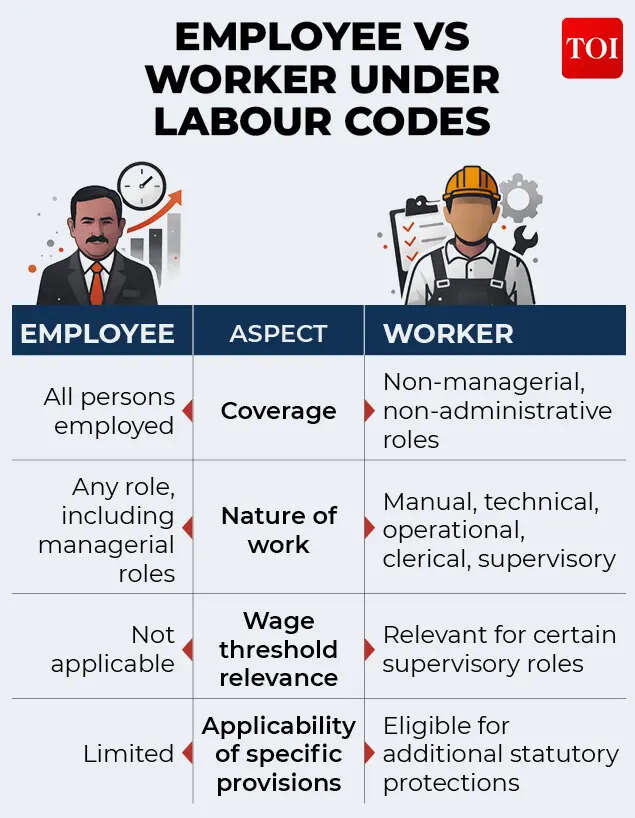
India’s new labour codes have introduced a structured distinction between the terms “employee” and “worker”. While all workers are employees, not all employees are workers. This distinction is more than just terminology – it determines the applicability of several statutory benefits and protections.The labour codes aim to simplify and consolidate India’s complex labour law framework. In doing so, they retain the principle that certain categories of roles – particularly those involving operational, manual or clerical work – may require specific safeguards. As a result, the concept of a “worker” remains central to how the codes are applied.This distinction is not limited to factories or industrial units. In today’s economy, many roles in offices, warehouses, retail outlets, and service centres may fall within the scope of “worker” depending on the nature of duties performed.Understanding the definition of “worker”The labour codes define a “worker” as someone employed to perform manual, skilled, unskilled, technical, operational, clerical or supervisory work. However, individuals in managerial or administrative roles are excluded. Supervisory employees may also be excluded if their wages exceed a specified threshold.The key factor is the nature of work performed—not the job title, salary level or workplace setting. This means that two employees in the same organisation, with similar designations, may be treated differently under the codes depending on their actual responsibilities. In contrast, the term “employee” is broader and includes all individuals engaged for hire or reward, regardless of their role. This allows the codes to apply specific provisions to workers while maintaining flexibility for other categories of employees.
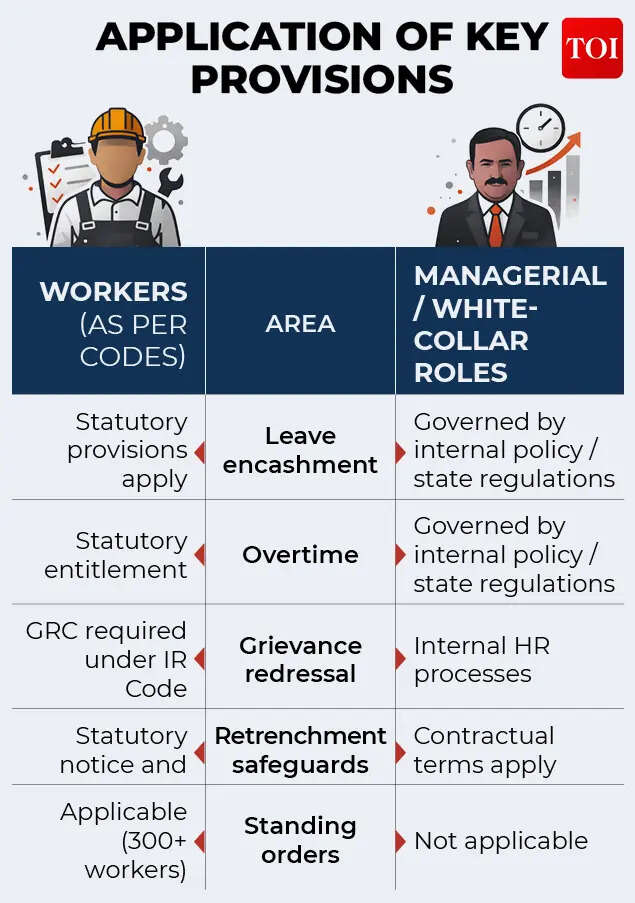
Key provisions applicable to workersThe labour codes provide a range of benefits and protections that apply specifically to workers. These include provisions on leave encashment, overtime, grievance redressal, retrenchment compensation, and standing orders. Below is a closer look at each of these areas.Leave encashment for workersUnder the Occupational Safety, Health and Working Conditions Code, 2020 (OSHWC Code), leave encashment provisions apply only to workers. The Code provides that workers are entitled to one day of earned leave for every 20 days of work in a calendar year, subject to a minimum number of days worked.At the end of the calendar year, workers may carry forward up to 30 days of earned leave. Any leave balance exceeding this limit must be encashed. Additionally, workers may request encashment of up to 30 days of leave at the end of the year, even if the carry-forward limit is not exceeded.All leave encashment is to be calculated based on the definition of “wages” under the labour codes, which includes basic pay, dearness allowance and retaining allowance, but excludes specific components such as house rent allowance, overtime allowance, statutory bonus, etc.Example: Where these provisions apply, a worker with 42 days of earned leave at year-end would have 12 days mandatorily encashed. The worker may also request encashment of the remaining 30 days.Overtime for workersThe OSHWC Code also provides for overtime pay for workers. Overtime is payable at twice the rate of wages and is applicable when a worker works beyond the prescribed limits.As per the draft Central Rules under the OSHWC Code, overtime becomes payable after 48 hours of work in a week. The maximum permissible overtime is 144 hours per quarter. Importantly, a worker’s consent is required before they can be asked to work overtime.Example: If an employee works 54 hours in a week, and the provisions apply, the 6 hours beyond 48 would be considered overtime and paid at twice the wages rate, subject to the worker’s consent and the quarterly cap.The 48-hour weekly threshold and 144-hour quarterly cap are based on draft rules and may be subject to change upon final notification.Grievance Redressal Committee (GRC)The Industrial Relations Code, 2020 mandates that every industrial establishment employing 20 or more workers must set up a Grievance Redressal Committee (GRC) to address individual grievances.The GRC must have equal representation from the employer and workers, with a maximum of 10 members. There must be adequate representation of women workers, proportionate to their share in the workforce. The committee is required to resolve grievances within 30 days of receiving an application.If a worker is dissatisfied with the GRC’s decision or if the grievance is not resolved within the stipulated time, the worker may escalate the matter to a conciliation officer or, subsequently, to an industrial tribunal.Example: Where this framework applies, a worker raising a concern about shift allocation or leave records would submit a grievance to the GRC. The committee would then follow a defined process and timeline to resolve the issue.Retrenchment and Worker Re-skilling FundThe Industrial Relations Code also outlines specific provisions for retrenchment. A worker with at least one year of continuous service is entitled to one month’s notice (or wages in lieu) and retrenchment compensation equivalent to 15 days’ average pay for each completed year of service.In addition, employers are required to contribute an amount equal to 15 days’ wages per retrenched worker to the Worker Re-skilling Fund. This fund is intended to support retrenched workers by crediting the amount to their accounts within 45 days of retrenchment.Example: Where these provisions apply, an organisation planning a workforce reduction would need to ensure that notice, compensation and re-skilling contributions are processed in accordance with the Code’s requirements.Standing OrdersThe standing orders framework under the Industrial Relations Code applies to industrial establishments employing 300 or more workers. Employers in such establishments are required to prepare and certify standing orders that define service conditions such as classification of workers, working hours, leave, misconduct, and disciplinary procedures.Employers may adopt the model standing orders issued by the Central Government or prepare their own, subject to consultation with trade unions or negotiating councils and certification by the appropriate authority.Where standing orders apply, organisations would document service conditions in a standardised format, ensuring consistency in how policies are applied across the workforce.
Rulings on worker definition – A summaryIndian courts have consistently emphasised that the classification of a worker depends on the actual duties performed, not merely on job titles or salary levels. Factors such as the degree of supervision, decision-making authority, and the nature of responsibilities are considered when determining whether an individual qualifies as a worker.These principles continue to guide the interpretation of the worker definition under the labour codes, especially in cases where roles may not fall neatly into one category.Finally,The labour codes provide a structured framework for distinguishing between employees and workers, with specific rights and protections linked to worker status. This distinction is relevant across sectors and applies equally to traditional industrial settings and modern workplaces.For organisations, the framework offers clarity on how different provisions apply to different categories of roles, supporting consistent and transparent workforce practices. For individuals, it enhances awareness of how statutory provisions relate to the nature of work performed.Overall, the labour codes aim to balance protection, flexibility and clarity—supporting both employee welfare and organisational efficiency in a unified legal framework.(Puneet Gupta is Partner, People Advisory Services Tax at EY India)