

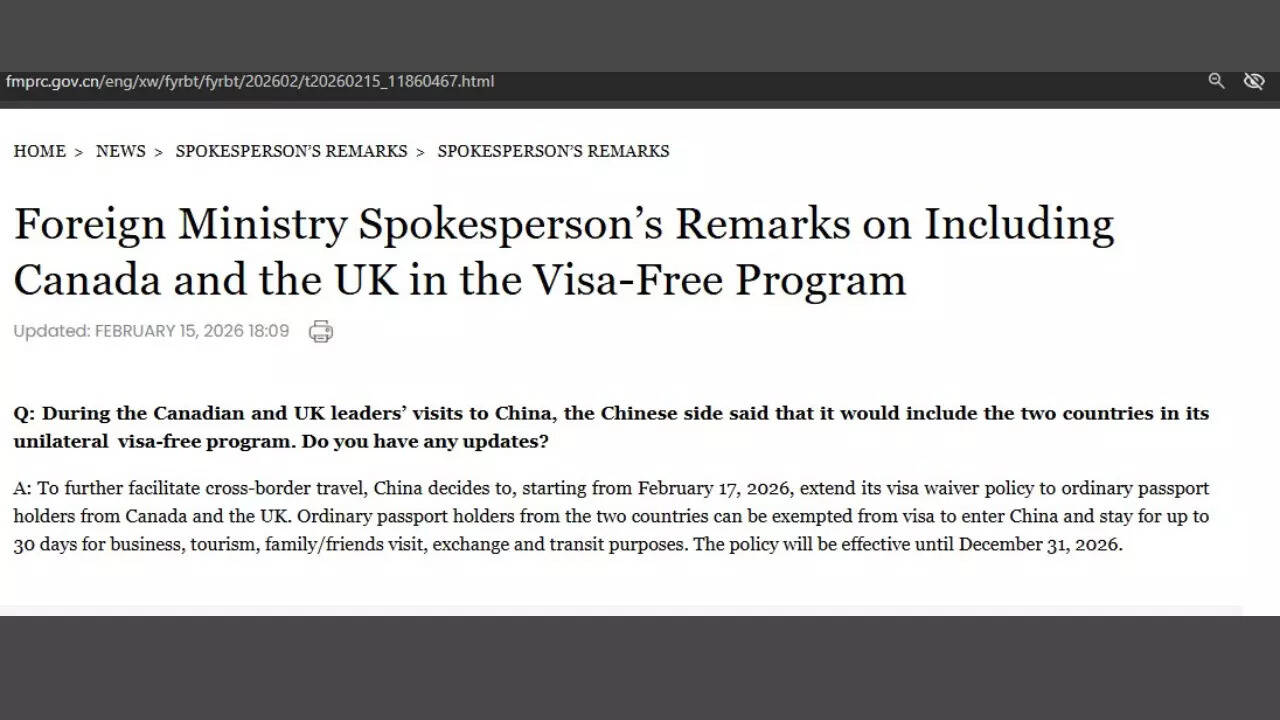
Starting from February 17, 2026, to facilitate cross border travel, China has decided to expand its visa waiver policy to holders of regular Canadian and British passports. The policy will allow qualified visitors from the two nations to enter China without a visa and remain for a maximum of 30 days for a variety of reasons, such as transit, business, tourism, visiting family or friends, or exchange programs.Also, when China eased its visa-free policy in 2025, it allowed citizens of 48 countries to enter the country without a visa for stays of up to 30 days. The easing of the visa-free policy was intended to make it easier for people to travel to China for business, tourism, visiting relatives, exchanges, and transit purposes while ensuring that there are proper regulatory guidelines at the borders. With the addition of 2 new countries in the list, the count of countries eligible for visa-free travel to China goes up to 50.
Who is eligible?
Nationals holding valid ordinary passports from the following 50 countries are eligible:Canada, United Kingdom, Brunei, France, Germany, Italy, Spain, Netherlands, Switzerland, Ireland, Hungary, Austria, Belgium, Luxembourg, New Zealand, Australia, Poland, Portugal, Greece, Cyprus, Slovenia, Slovakia, Norway, Finland, Denmark, Iceland, Andorra, Monaco, Liechtenstein, Republic of Korea, Bulgaria, Romania, Croatia, Montenegro, North Macedonia, Malta, Estonia, Latvia, Japan, Brazil, Argentina, Chile, Peru, Uruguay, Saudi Arabia, Oman, Kuwait, Bahrain, Russia and Sweden.
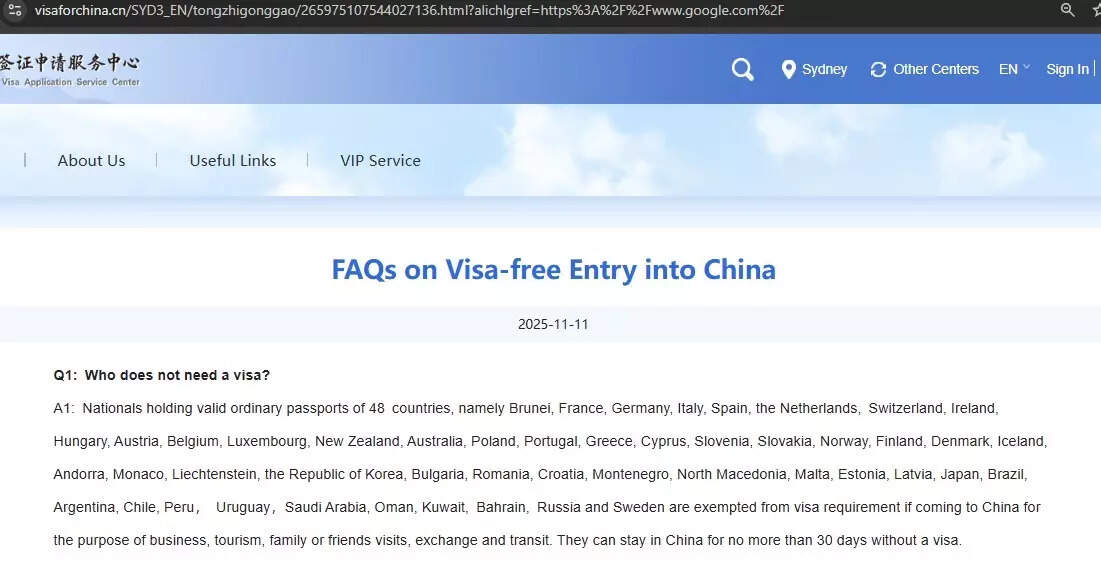
Eligible travellers may stay in China for up to 30 days without a visa, provided the purpose of travel falls under approved categories.Read more: Kuno National Park in 2026: Where India’s cheetah comeback is unfolding in real time as cheetah population reaches 38
Permitted purposes
The visa waiver applies to travel for:
- Business
- Tourism
- Visiting family or friends
- Exchange programmes
- Transit
- Sports competitions
- Conferences and exhibitions
- Study tours (including summer and winter camps)

Duration of stay
The 30-day stay is calculated from the day after entry and covers 30 calendar days. Those planning to stay longer must apply for the appropriate visa in advance through Chinese embassies or consulates.If unexpected circumstances require an extension after entry, travellers must apply for a stay permit with local exit-entry administration authorities.
Passport requirements
Travellers must hold an ordinary passport valid for at least the duration of their intended stay.Holders of temporary, emergency, or travel documents other than ordinary passports are not eligible for visa-free entry.Entry and border checksChinese border inspection authorities will examine the purpose of travel upon arrival. While a visa is not required, travellers are advised to carry supporting documents such as:Invitation lettersReturn or onward air ticketsAccommodation bookingsEntry may be refused if the declared purpose does not meet waiver conditions or if the traveller violates Chinese laws and regulations.
Travel routes and transport
The visa waiver applies to travellers arriving through any sea, road, or airport open to foreign nationals, unless otherwise restricted by specific laws or bilateral arrangements. It also applies whether travellers depart from their home country or from a third country.Those entering by private transport must comply with additional entry-exit procedures for vehicles under Chinese regulations.
Multiple entries
Eligible nationals may enter China multiple times without a visa. Currently there is no restriction on the number of entries. However, travellers must not engage in activities inconsistent with their declared purpose of entry.Read more: 4-day Noida Flower show opens with grand Kedarnath temple replica, free entry for visitors
Minors and tour groups
Visa waiver rules for minors are the same as for adults. The policy applies equally to individual travellers and tour group participants.
Lost passport procedures
If a visa-free traveller loses their passport after entry, Chinese border authorities will verify identity, entry records, and documentation issued by the relevant embassy or consulate in China. Exit may be permitted if the traveller has not overstayed or committed violations.If overstaying or other infractions occur, authorities will handle the case according to Chinese law before permitting departure.