

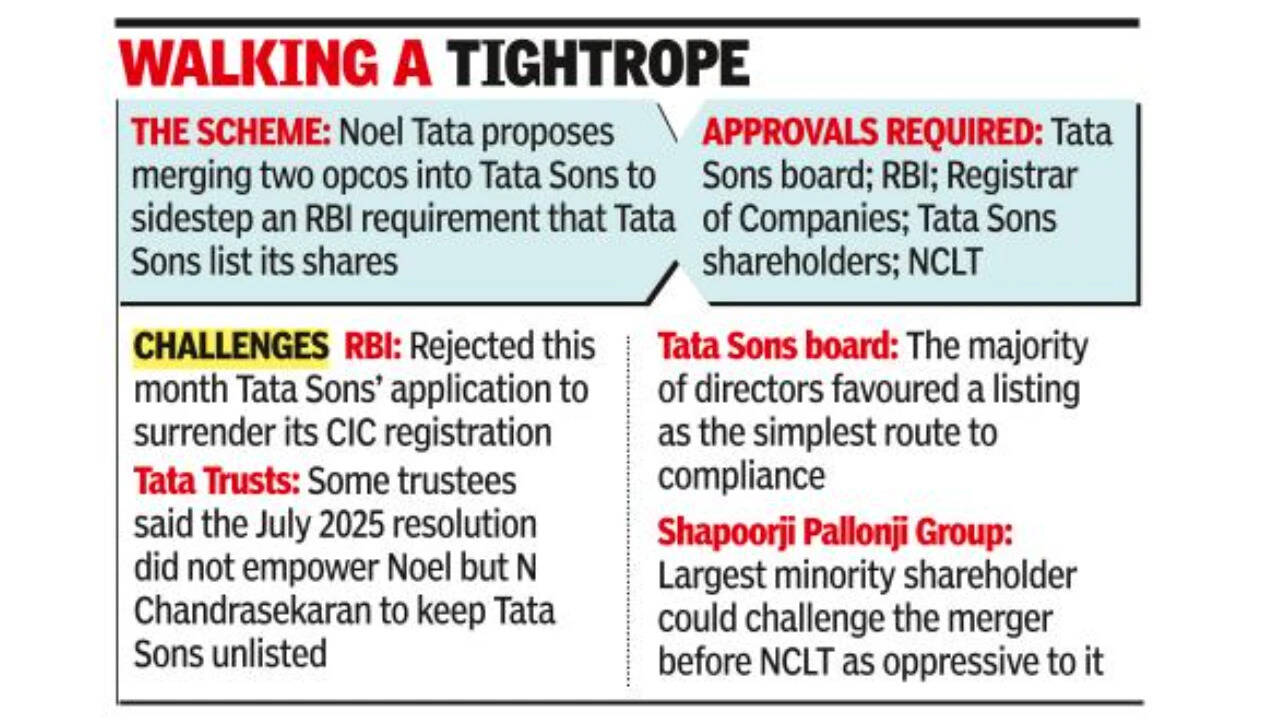
MUMBAI: Noel Tata’s plan to keep Tata Sons private faces five hurdles, the steepest of which is a Reserve Bank of India (RBI) that has already refused to release the group’s holding company from its rules. The chairman of Tata Trusts has proposed merging Tata Electronics Systems Solutions and Tata Consulting Engineers into Tata Sons, a move designed to take the holding company outside the RBI’s upper-layer NBFC and Core Investment Company regulations, and so avoid a public listing. Success depends on winning over his own trustees, a divided Tata Sons board, the central bank, an aggrieved minority shareholder and a 75% vote he cannot yet count on.
Tata Trusts
Dissent persists at home. Noel emailed the merger proposal to trustees Monday in his capacity as chairman of Tata Trusts, relying on a July 28, 2025 resolution. But some trustees said the resolution empowered N Chandrasekaran, chairman of Tata Sons, not Noel, to keep Tata Sons unlisted and to engage with the RBI. They added that no board meeting was held to weigh the proposal before it was unveiled. They also questioned whether the Tata Sons board can consider the plan without approval from both the Sir Dorabji Tata Trust and the Sir Ratan Tata Trust (SRTT), the latter currently under a regulatory restriction.
The Tata Sons board
The board is split 5:1, and the majority sees a listing as the simplest route to compliance. Noel can seek a board meeting to consider the plan, but he needs the backing of fellow Trusts nominee director Venu Srinivasan. On Noel’s reading of Article 121 of Tata Sons’ Articles of Association, the merger fails if one Trusts nominee votes against. By Tata Sons’ reading, if the Trusts’ nominees vote in different directions, the result would be a split and Chandrasekaran would have the chairman’s casting vote. Srinivasan had backed Chandrasekaran’s reappointment; only Noel had opposed. Add the majority view that an IPO offers greater regulatory certainty than a restructuring, and the outcome looks stacked against Noel.
Reserve Bank’s NOC
The regulator is the most formidable obstacle. Earlier this month it rejected Tata Sons’ application to surrender its CIC registration, even though the company had repaid more than Rs 30,000 crore of debt. That keeps alive the requirement to comply with the upper-layer NBFC-CIC rules including listing. The merger is designed to ensure Tata Sons no longer qualifies as an NBFC or a CIC, but the RBI’s 2025 NBFC-voluntary amalgamations directions require an explicit no-objection certificate (NOC) for the proposal as part of the National Company Law Tribunal (NCLT) approval process. The RBI is also likely to weigh longer-term prospects: if the merged businesses are later demerged to attract outside investment or an IPO, Tata Sons would revert to NBFC-CIC status.
Shapoorji Pallonji Group
The largest minority shareholder in Tata Sons, the Shapoorji Pallonji (SP) Group, has long advocated a listing to unlock value. Scrapping the prospect of an IPO could prompt SP to challenge the restructuring before the NCLT as oppressive to them.
Tata Cos’ vote might be key
The Trusts collectively own 66% of Tata Sons, but SRTT with 24% cannot currently vote on the merger because of the regulatory restriction. That makes Tata companies, which hold 13%, pivotal as the resolution requires 75% of shareholders to approve it. Their stance is unclear, and they are led by Chandrasekaran. If Tata companies and SP, which holds an 18% stake, both vote against, the restructuring resolution fails.