Chile’s Atacama Desert is the driest non-polar desert on Earth, and it is not what we imagine a desert to be!While most deserts across the world are lined with large stretches of sand and golden dunes, this desert resembles the landscapes of Mars!This might sound like a movie green screen set up only for shooting in Martian lands; it is actually true!Rain is not scarce here so much as functionally absent, and that absence has turned a stretch of desert near Antofagasta into one of the most valuable pieces of ‘real estate’ in planetary science.NASA has sent teams back year after year, not just for getting snaps, but because the soil itself behaves like Martian soil, tricking the very instruments built to detect life; but what follows next is as surprising as why the “driest” spot might not even be the driest one at all.
The area that received only 2 mm rainfall in 4 years!
Near Yungay, roughly 80 kilometres from Antofagasta, Christopher McKay and colleagues ran a weather station for four years and recorded a single precipitation event of 2.3 millimetres. Their 2003 dataset, published in the journal Astrobiology, found liquid water present in the soil for only 65 to 85 hours across the entire period. Dew formed regularly but added almost nothing. A powerful 1997–98 El Niño soaked deserts to the north while leaving the central Atacama completely untouched.
What is the rainfall measured in millimetres per decade?
Across the driest stretch of the Atacama, annual precipitation stays under 2 millimetres, and in some interior basins researchers track rainfall by the decade rather than the year. NASA’s field reports said that some sites receive roughly one centimetre of rain every ten years.Making it a place where “average annual rainfall” becomes almost a meaningless statistic, because most years contribute nothing to the average at all.
A city that went 172 months without a drop
The longest verified dry spell on record belongs to Arica, a coastal city on the desert’s northern edge. The World Meteorological Organisation recognises 172 months for over 14 years, without measurable precipitation, from October 1903 to January 1918. Unlike the hyperarid core’s remote research stations, Arica has had someone reading a rain gauge continuously for over a century, which is precisely why this particular record has survived.
Soil that fooled the hunt for life on Mars
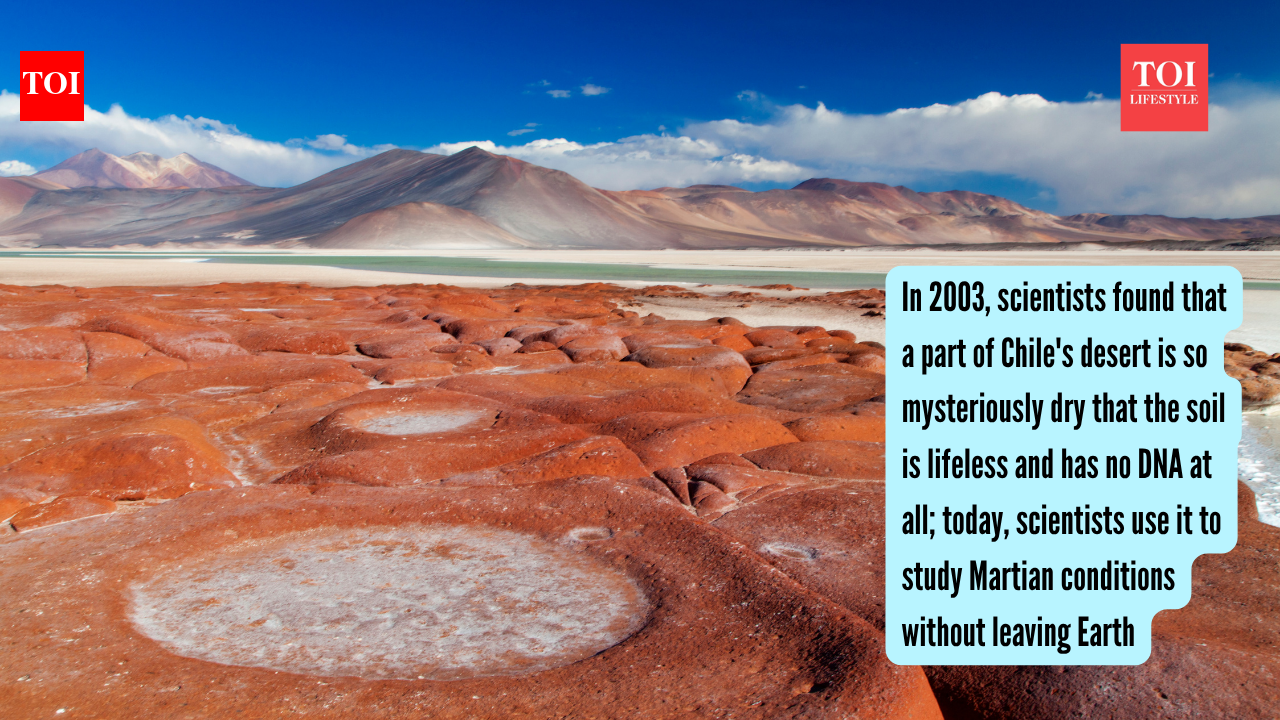
In November 2003, Rafael Navarro-González and Chris McKay’s team testedsoil from the Atacama and found almost nothing alive in it, just trace amounts of organic material and barely any bacteria that would even grow in a lab dish.Two soil samples came back with no DNA at all. Then they ran the same test the Viking landers had run on Mars back in 1976, and the soil did something strange: it broke down organic matter all on its own, with no living thing involved.Which is quite similar to what a scenario on Mars looks like, as scientists are always skeptical of finding any signs of life on Mars.
The “driest place on Earth ” might have a rival
Yungay became astrobiology’s favorite testing ground because it was easy to get to, not because anyone had actually checked whether it was the driest spot in the desert.Turns out it wasn’t. In 2015, Armando Azua-Bustos and his team found a place called María Elena South that was even drier, where average humidity sat at just 17.3%, compared to 28.8% at Yungay. That’s dry enough and closer to the readings NASA’s Curiosity rover has taken on Mars itself, at Gale Crater.
But what sets the Atacama Desert apart?
What makes this place similar to Mars’ landscape isn’t simply that the Atacama is dry, in fact, there are plenty of dry places. It’s that the mechanism behind its dryness- where the Andes block Amazonian moisture, the cold Humboldt Current locks in a temperature inversion, and a subtropical high presses air downward, which produces soil chemistry that is similar to MarsEvery dataset here, from a single 2.3-millimetre rainfall to a 172-month dry spell to soil that erases its own DNA, helps rehearse a Mars mission without leaving the planet.