For someone who cannot see, taking the right medicine at the right time can involve more than remembering a prescription. Two tablets may look alike to a sighted person, but identifying them by touch can be equally difficult when their shapes or textures are similar. A mix-up could mean taking the wrong medicine or missing a dose.Rehan Raza, a visually impaired student from Hyderabad, began thinking about this everyday problem after speaking to friends at Devnar School for the Blind. What stayed with him was the dependence some visually impaired people had on their parents to identify medicines and hand them the correct tablets.Instead of treating this as an unavoidable difficulty, Rehan began looking for a solution. His answer was a talking medicine box designed to tell users what medicine is stored inside, how much they need to take and when they should take it.The invention, called the Smart Medicine Box for the Visually Challenged, has now earned national recognition, putting the young innovator’s practical approach to accessibility in the spotlight.
A problem he understood personally
According to The New Indian Express report, Rehan’s idea grew out of a question that was close to home. Being visually impaired himself, he understood the challenges of navigating everyday tasks without relying on sight. Conversations with his schoolmates helped him recognise how something as routine as taking medication could become complicated when several medicines had to be distinguished.“I am visually impaired myself. When I was studying at Devnar School for the Blind, I had friends who were also visually impaired. Some of their parents were visually impaired too,” he told The New Indian Express.He recalled asking his friends how they identified their medicines. They explained that their parents often relied on touch, but this method could become unreliable when two medicines felt similar.“But if two medicines felt similar, there was a possibility of confusion,” Rehan said, explaining the thought that led him to develop the box.It was a problem that did not necessarily call for an elaborate technological intervention. What users needed was a dependable way to identify the medicine before taking it, without having to ask another person each time.Rehan’s design centres on that simple idea: give users access to medication instructions through sound, allowing them to make more informed decisions independently.
How the talking medicine box works
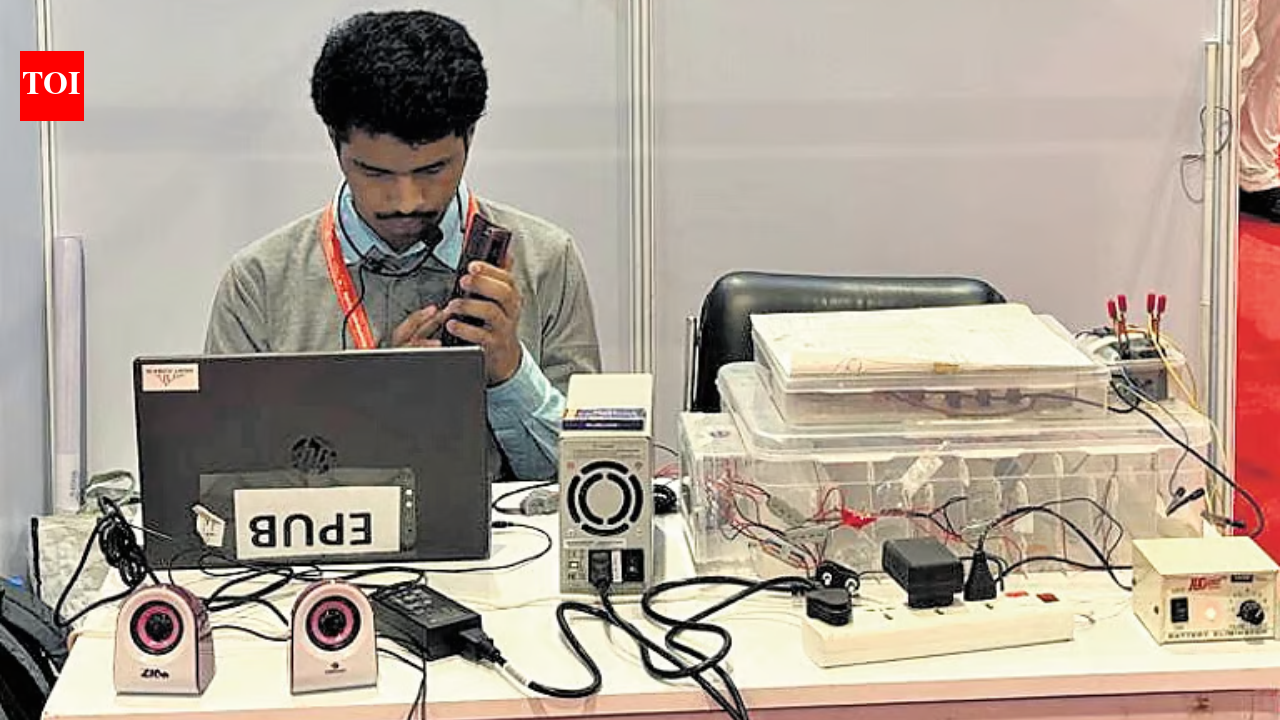
The device has five compartments. One is meant to store a prescription, which can be written in Braille, while the other four hold individual medicines.Its main feature is a voice-recording and playback module. Each medicine compartment has a dedicated button that plays recorded instructions, telling the user the medicine’s name, prescribed dosage and time of intake. The user can listen to the instructions before opening the compartment and accessing the medicine.The process of preparing these recordings also incorporates technology. According to the report, Rehan used an AI-powered feature in a mobile application to scan a medicine and retrieve information about it. These details can then be recorded in the box’s voice module, so users do not have to scan the medicine every time they need to take it.The box also has automatically opening compartment doors and an alarm that can be set to remind users when their medicines are due. It can operate using either a direct power supply or a battery.Together, these features are intended to make it easier for visually impaired users to manage their medication routines, particularly when they have to keep track of different tablets and schedules.
From a school project to national recognition
Rehan’s invention was among five projects from Telangana selected for recognition at the 12th National INSPIRE Awards-MANAK Exhibition, held at Bharat Mandapam in New Delhi from October 12 to 14.Nearly 780 projects were showcased at the exhibition, of which 62 received national recognition. Telangana secured five awards, finishing third nationally.The recognition places Rehan among students whose projects seek to address practical challenges through innovation. His device stands out for focusing on an everyday need that can easily be overlooked: the ability to manage one’s own medication without having to depend on someone else to identify every tablet.For people with visual impairments, accessibility is not only about navigating public spaces or using digital devices. It can also mean being able to carry out routine activities at home with greater confidence and independence.A medicine box that speaks cannot remove every difficulty associated with managing medication. However, by combining audio instructions, Braille and reminders in a single device, Rehan’s design attempts to make one important part of daily life more manageable.
An aspiring engineer with a practical approach
After completing his matriculation at Devnar School for the Blind, Rehan moved on to a junior college, where he is pursuing his Intermediate education. He is also preparing for engineering entrance examinations, including JEE Main and EAMCET.His invention reflects an approach to problem-solving that begins with observing how people manage everyday situations and asking whether those routines can be made easier.For Rehan, the starting point was not a complicated technical challenge. It was a conversation with friends and a concern that people who were already navigating life without sight should not have to rely entirely on others to distinguish between medicines.The Smart Medicine Box for the Visually Challenged grew out of that concern. Its national recognition has brought attention to an idea built around a straightforward goal: helping people hear the information they need to take their medicines with greater independence.Sometimes, an innovation begins not with seeing something that others have missed, but with understanding a problem that others may never have had to face.