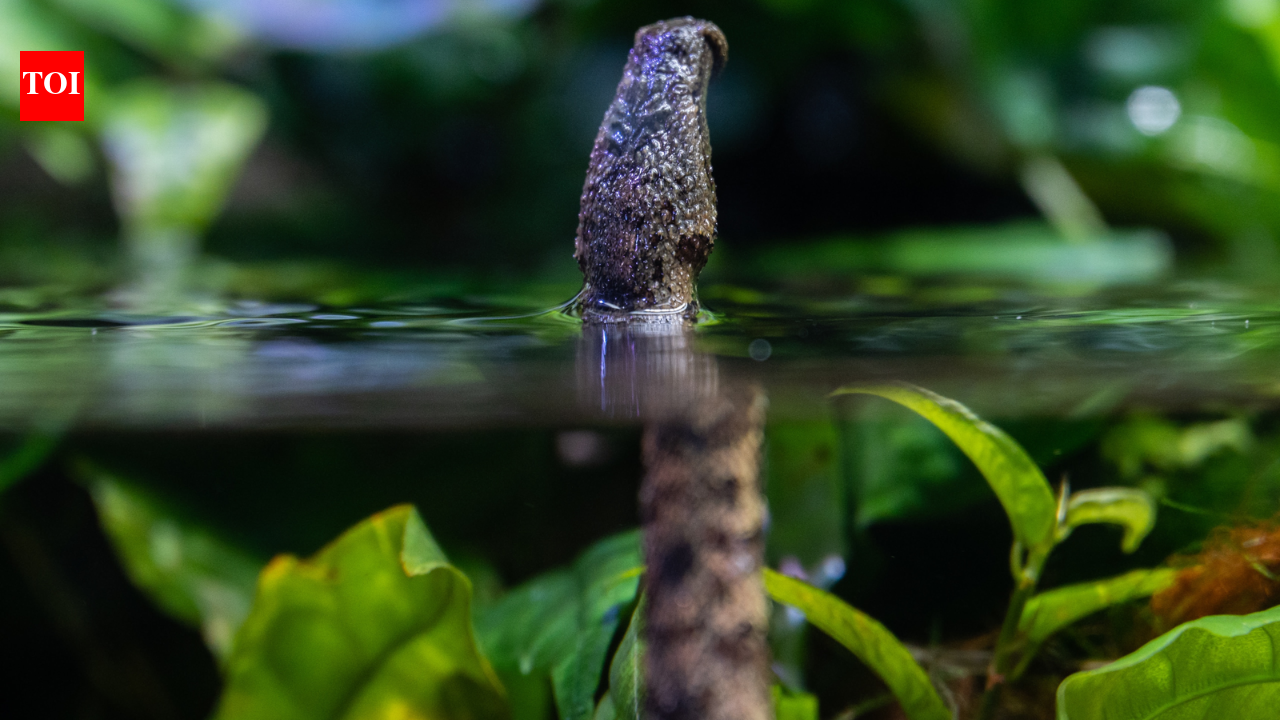
The fish makes the move it was built to make: escape. In a flash, its body bends into a C-shape and it darts away from danger. Except this time, the escape takes it straight towards the predator’s jaws.The hunter is the tentacled snake (Erpeton tentaculatum), an aquatic snake with two small, fleshy projections near its snout. It waits in the water with its body curved into a J, then makes a tiny movement just before striking. That movement startles nearby fish, triggering their rapid escape reflex, but often in exactly the wrong direction.
A hunter that turns the fish’s instincts against it
For most fish, the C-start is an exceptionally useful emergency manoeuvre. When a threat approaches, specialised nerve cells in the brainstem help trigger a rapid bend of the body, allowing the fish to accelerate away. The response can begin within milliseconds, before the animal has time to make a more considered decision.But the tentacled snake has found a way to exploit that speed.Kenneth C. Catania, a neuroscientist at Vanderbilt University, investigated this unusual hunting behaviour by filming the snakes and their prey at high speed. His research, published in Proceedings of the National Academy of Sciences in 2009, showed that the snake makes a small body movement on the side of the fish opposite its approaching head. This creates a disturbance in the water that triggers the fish’s escape response.The fish usually turns away from that disturbance. Unfortunately, the snake’s jaws are positioned in the direction the fish is now swimming.The predator has not disabled the fish’s reflex. It has manipulated the circumstances in which the reflex operates.
The snake can aim where the fish is going to be
The trick becomes even more impressive when the fish approaches the snake from a different angle.If the fish is positioned at roughly a right angle to the snake’s jaws, its escape manoeuvre may send it sideways rather than directly towards the predator. The snake adjusts its attack, aiming for the place where the fish’s head is likely to move.Catania tested whether this ability depended on experience. He observed 10 laboratory-born snakes that had not previously hunted fish, recording their strikes at 250 or 500 frames per second.Across 100 trials, the fish displayed the C-start response 88 times. In 74 of those instances, they escaped away from the snake’s body feint. The inexperienced snakes nevertheless directed their strikes towards the fish’s predicted future position.That finding raised a fascinating evolutionary question: how could a snake respond so effectively to the movement of prey that had not yet happened?The research suggested that this predictive behaviour is at least partly innate. Natural selection appears to have favoured snakes whose nervous systems are adapted to anticipate the escape patterns of fish. They do not need to learn every detail of the manoeuvre through repeated hunting attempts.Its strategy also illustrates a broader principle in evolution: an adaptation that normally helps one animal survive can become a weakness when a specialised predator learns to exploit it. The fish’s C-start is not a bad design. It works against many threats. The tentacled snake is unusual because it has evolved to take advantage of that otherwise effective response.The snake’s hunting technique is therefore more than a curious wildlife spectacle. It is a window into how nervous systems, reflexes and predator-prey relationships evolve together.For the fish, the split-second decision is meant to mean survival. For the tentacled snake, that same decision can deliver dinner.