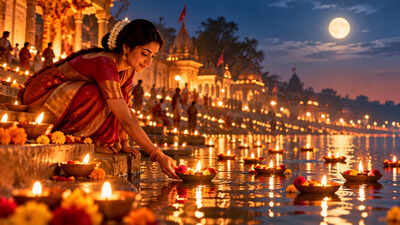
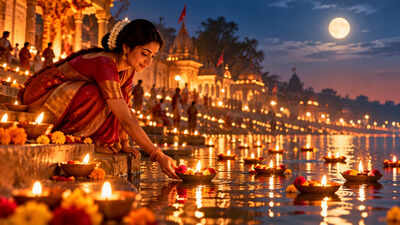
Walk along the ghats of Varanasi any evening in Kartik, and you’ll see small leaf-boats drifting on the Ganga, each carrying a tiny flame. In villages, women place diyas under the tulsi plant at dusk. Temples glow with rows of lamps. Some homes hang a lantern high on a bamboo pole, swaying above the rooftops. Kartik is the month of lamps in Hindu tradition, and Diwali, the brightest night of all, falls right inside it. The practice at the heart of all this light is called deepdaan, the offering of a lamp.
A Month When Light Is Needed Most
Kartik arrives as the days grow shorter and the nights cooler. The monsoon is over, the harvest is in, and the year moves toward its darkest stretch. Lighting a lamp at such a time is both practical and symbolic. It pushes back the early evening and reminds the household that darkness never has the final word.The month also carries deep religious meaning. According to tradition, Lord Vishnu rests through Chaturmas, the four months of the rainy season, and wakes on Prabodhini Ekadashi, which falls in the bright half of Kartik. This year it comes in the third week of November. The lamps of Kartik are, in a sense, a welcome for the awakening god.For Vaishnav devotees, Kartik is also Damodar month, honouring Krishna as the child Damodar, bound to a mortar by his mother Yashoda. Offering a ghee lamp to Damodar each evening while singing his praises is one of the month’s most loved practices.The Puranas describe deepdaan in Kartik as especially meritorious. A single lamp offered with devotion in this month is said to bring blessings far greater than at other times of the year.
What Deepdaan Symbolises
A lamp is simple. Clay, oil and a cotton wick. Yet each part carries meaning.The clay vessel is the human body, of earth, and returning to earth. Oil or ghee is the devotion, the steady feeling that keeps a spiritual life burning. The wick is often likened to the ego. It slowly gives itself away in creating light as it burns. And the flame itself represents the atma, the inner light that never truly goes out.So offering a lamp is offering oneself. It’s a quiet way of saying: let my ego burn down, and let only what is pure remain.The flame also always rises upward, whichever way the lamp is tilted. Many teachers describe that as a reminder to keep thoughts pointed toward higher goals, even when life tilts in difficult directions.
The Many Forms of Deepdaan
At rivers and lakes. Floating a lamp on water, especially at dawn or dusk, is one of the most common forms. It’s linked with Kartik snan, the ritual bath many devotees take early each morning through the month.Before tulsi. The tulsi plant, sacred to Vishnu, is lit with a lamp every evening in many homes. Tulsi Vivah, the ceremonial marriage of tulsi to Lord Vishnu, follows Prabodhini Ekadashi and marks the start of the wedding season.Akash deep. A lamp or lantern is hung high on a pole outside the house for the whole month. It’s meant to guide ancestors and to carry light toward the heavens.For Yama. On the evening of Dhanteras, November 6 this year, families light a lamp facing south for Yama, the god of death. This Yama deepdaan is believed to protect the household from untimely death.In temples. Offering lamps at a Shiva or Vishnu temple, or at a peepal tree, is common on Mondays and Ekadashis during Kartik.The month ends with Kartik Purnima, which this year falls around November 24. In Varanasi, it’s celebrated as Dev Deepawali, when the ghats are covered with lakhs of diyas, said to be lit for the gods themselves.
Lighting a Lamp at Home
Deepdaan doesn’t need a river or a grand temple. A clay diya with ghee or sesame oil, lit in the evening near the tulsi or in the puja corner, is enough. Many families light one in the north-east corner of the home, considered the most sacred direction.The key is regularity and intention. A single lamp lit every evening through Kartik, with a moment of quiet prayer, carries more meaning than a hundred lit carelessly on one night.