

By Archit GuptaEvery person’s personal finance rests on three things. The first is protecting yourself and your family through life and health insurance. The second is your home, and the loan that usually comes with it. The third is building wealth, turning your savings into a corpus that grows over time, whether that corpus is a retirement fund decades away or simply money set aside for a year-end holiday. What ties the three together is that each has a tax side.The insurance you buy, the home loan you service, the investments you choose- every one of them can shape your tax, and deciding on them thoughtfully can leave more money in your hands. That is why tax planning works best not as a year-end scramble in March, but as a steady, year-round discipline woven into these everyday decisions. Here is how a salaried employee can approach it across twelve months.
Start with an estimate, in April
The foundation of good planning is an early estimate of your liability. At the start of the financial year, add up your expected salary, any income outside it such as interest, rent or capital gains, and the deductions you realistically expect to claim. This one exercise tells you your likely tax for the year, and it is what every later decision rests on. Without it, you are saving and investing blind, and you discover your actual position only when it is too late to change it.An estimate also reveals the size of the decision in front of you. Someone who will owe very little needs to do almost nothing; someone with a larger liability can see exactly how much planning is worth, and plan proportionately.
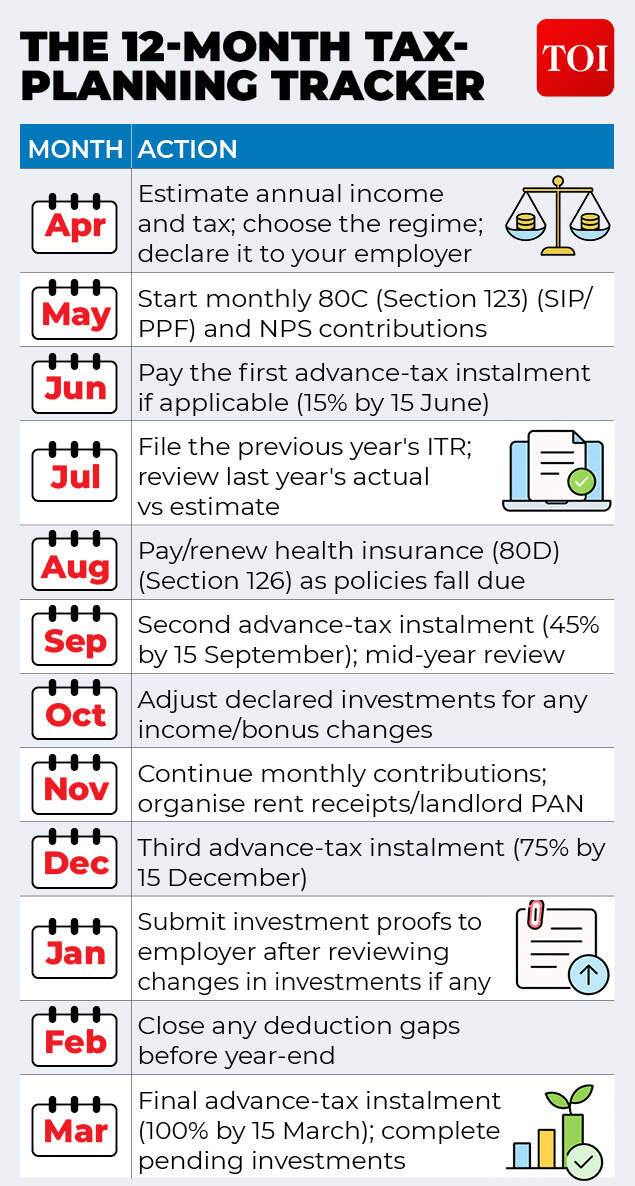
The 12-month Tax-Planning Tracker
Choose the regime deliberately, not by habit
The most consequential decision is which tax regime to use. The new regime, now the default, offers lower rates across wider slabs but withdraws most deductions. The old regime keeps higher rates but allows house rent allowance, Section 80C investments, health insurance under Section 80D, home-loan interest and more.The practical way to choose is a break-even test: the old regime is cheaper only if your total deductions cross a break-even level, and that level rises with income. Take a salaried person earning around Rs 20 lakh a year. For the old regime to beat the new, they would need roughly Rs 7 lakh of deductions, over and above the standard deduction. At exactly that break-even point, both regimes leave them with the same tax, a little over Rs 1.9 lakh.If their deductions fall short of that, the new regime is cheaper and simpler; if they comfortably exceed it, the old regime pulls ahead. For many salaried people, especially those without a home loan or large Section 80C commitments, reaching that level is difficult, which is why the new regime often works out better by default.The real error is not choosing one regime over the other; it is choosing out of habit without running both sets of numbers on your own income. This decision belongs at the start of the year, not at filing, because the regime you expect to use sets how much tax your employer deducts each month.
Align your TDS with reality
Your employer deducts tax every month based on the regime and investments you declare, so declaring them early keeps your monthly deductions accurate and your take-home steady. The part that needs your active attention is income your employer cannot see: interest, capital gains or freelance earnings.Where your tax on that, after TDS, is likely to exceed Rs 10,000 for the year, it must be paid as advance tax in instalments across June, September, December and March. Tracking it through the year avoids a last-minute crunch and the interest that comes with missing it.
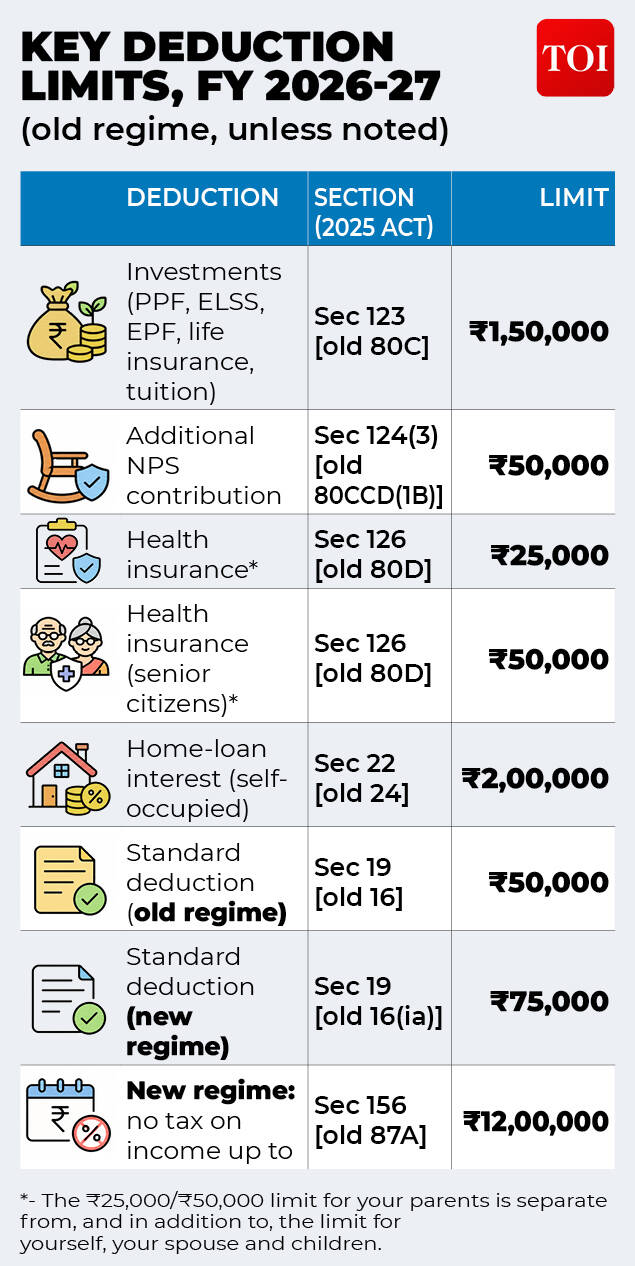
Key deduction limits FY 2026-27
Spread your deductions across the year
The heart of year-round planning is spreading deductions over twelve months instead of bunching them into March.Under Section 80C, up to Rs 1.5 lakh is deductible. Rather than a single lump sum in March, a monthly contribution, a SIP into an equity-linked savings scheme, or regular provident fund and PPF additions spreads the cost and averages your investment price. Your EPF contribution and your children’s tuition fees already count towards this limit.Health insurance, under Section 80D, allows up to Rs 25,000, rising to Rs 50,000 where you insure senior-citizen parents, a separate limit from your own family’s cover. Paying premiums when the policy falls due, rather than scrambling in March, keeps both the cover and the deduction intact.The National Pension System offers an additional Rs 50,000 deduction under Section 80CCD(1B), over and above 80C. A small monthly contribution builds this painlessly. Notably, an employer’s NPS contribution under Section 80CCD(2) remains available even under the new regime, one of the few benefits that survives it.If you pay rent, keep your rent receipts and your landlord’s PAN, which is required where annual rent crosses Rs 1 lakh, through the year rather than reconstructing them at the end. Treated monthly, these choices ease cash flow and, more importantly, get made for sound financial reasons rather than to beat a deadline.
Review at the midpoint
Plans drift. A bonus, a job change, a new source of income or a shift in investments can all move your liability.A single mid-year review, around September or October, lets you correct course: adjust your declared investments, top up a shortfall, or revise your advance-tax estimate while there is still time to act.
Do’s and don’ts for regime selection
Do run both regimes on your actual numbers before deciding, and decide at the start of the year. Do declare your regime and investments to your employer early. Do keep documentation through the year. Do revisit the decision if your income changes.Don’t lock money away or buy insurance purely to save tax; the deduction should follow a genuine need, not drive it. Don’t leave the regime to default or habit without checking. Don’t wait for March, when rushed proofs and hurried investments are exactly where costly mistakes are made. And don’t overlook income outside your salary, which can quietly trigger advance tax.Done steadily, tax planning stops being stressful. It turns a deadline into a routine, aligns your tax with your actual financial life, and usually leaves more money in your hands. The best time to begin is the first month of the financial year, not the last.(The author is Founder and CEO, ClearTax)